You only live forever in the lights you make
When we were young we used to say
That you only hear the music when your heart begins to break
Now we are the kids from yesterday --My Chemical Romance, "The Kids from Yesterday"Wild men who caught and sang the sun in flight,Unfortunately a bunch of random distractions and a broken laptop kept me from getting my elegy out in as timely a fashion as I would like, but despite my tardyness, I'm going to plow ahead with this piece, because, well, when an era comes to an end you mark its passing, yeah?
And learn, too late, they grieved it on its way,
Do not go gentle into that good night. --Dylan Thomas, "Do Not Go Gentle Into That Good Night"
And it's hard for me to imagine a moment of greater artistic upheaval than the breakup of My Chemical Romance.
I'm not really going to apologize for that statement, as absurd as it might sound to folks who only know the band casually or are part of the sometimes vocally misguided hatedom. Hell, it probably would seem pretty strange to most of my fellow scholars as well, given MCR's reputation for adolescent theatrics and emotionally-charged hysterics.
But you know what? MCR was one of the most vital and dynamic bands of my generation, and they deserve a sendoff that acknowledges the heights to which they climbed in their best moments. Even if Gerard Way, the multitalented frontman of the band, wanted the music to speak for itself, I wouldn't be doing right--I wouldn't be doing the proper observances--if I didn't say a few words.
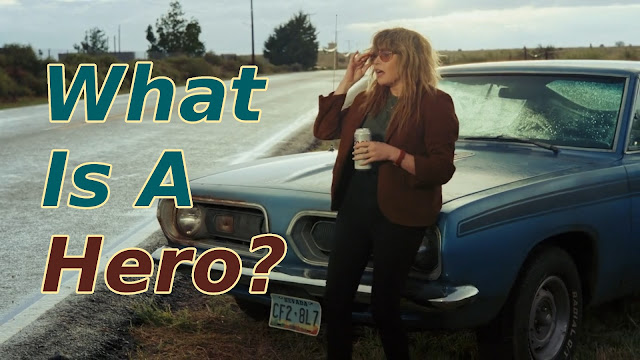
"I'm so overcome by emotion I'm just going to languish here on this car hood, ok?"
So come one, come all to this tragic affair: let's talk about why My Chemical Romance is, was, and forever will be an incredible band.
Your Shadow Lives On Without You
Alright, so that previous statement was kind of a lie. I'm really going to only talk about one specific aspect of what makes My Chem incredible. There's just too much else to look at, so I'm going to narrow it down. I want to take a particular look, actually, at the way they grapple with mortality. The breakup drew that theme into focus for me in a striking way. Suddenly a lot of their music was recontextualized, and the blazing gun fights and dramatic deaths that conclude Danger Days, their last album, felt a lot more like a big honking metaphor for the band's existence and final blazing glory.
The thing about MCR is that their songs are about death, more often than not. Which is, like, duh, totally obvious and all that. They have a whole concept album completely about death, for goodness sake. But there's a particular treatment of the idea of mortality that I want to dig into here, and that I think explains a lot of the persistent power of the band.
See, that phrase "grapple with mortality" wasn't accidental--part of what makes the band so interesting is the fact that they confront Death and vie with it for dominance. Losing to death involves going out fighting, going out in a blaze of glory in a hail of gunfire, or sometimes even just shouting, to the last, their desire to live. They do not go gentle into that good night, as Dylan Thomas says.
And really, this is quite a tough set of steps to dance to. Most artists, in my experience, end up stumbling in one way or another, largely because we still have this dopey idea in our culture that death is something we should accept as natural.
Pictured: Gerard Way staring death in the face, here personified by comic writer Grant Morrison. Fittingly? Probably.
Look: I'm a transhumanist. I object to Death in the strongest possible terms. I can't support it politically or ethically.
But that sometimes puts me in a bit of a quandary, because if one of the functions of art is to speak to the human experience in a cathartic and consoling way, you've got to find some way artistically of easing the sheer mindbending horror that is mortality--especially for those of us who ARE doomed, who are NOT going to be part of the statistical few who manage to live long enough for medicine to advance faster than the entropy of our failing meat engines.
Luckily for us, Way is not the singer that we wanted, but a dancer--and MCR manages to dance this knife edge without stumbling, as so many artists do, into the idea that eventually we need to passively accept death--that we must, to borrow Way's own expression, become victims.
Welcome to the Black Parade is actually a great example of this; possibly the best example in the bands repertoire, when you get right down to it.
Check it out:
Now, for those who don't know, the concept here is that when a person dies, they meet a psychopomp wearing the visage of their fondest memory. In other words, they're carried off to oblivion by the thing that will most comfort them in their time of need.
Wow.
What an incredible concept. I mean, really, that's an idea brilliant enough to carry a whole series of comics. If Gaiman and others could get a number of comics and graphic novels out of just the basic concept of Death anthropomorphised as a perky goth girl, surely this idea could carry the same weight.
And it's actually quite a comforting idea, I think. The prospect of ascending to the void in a triumphant parade of your greatest joy, coming to take away your final pain... yeah, for someone who has no other way out, that'd be a comfort, I think.
But.
While the visuals depict this notion of the Black Parade coming to take you away, take you today (and it's no coincidence, folks, that the band is borrowing imagery here from the Beatles! They're literally wearing their influences on their sleeves here, and this whole album is a psychadelic journey just as much as Magical Mystery Tour or Pink Floyd's The Wall was.) the lyrics tell a somewhat different story. Here, the consolation prize offered isn't just the prospect of a nice last hallucination as your brain slowly shudders to a halt.
No, the consolation is that you fought.
Defiant to the end, you fought for your life, and in some way you met death on your own terms.
And though you're dead and gone, believe me, your memory will carry on, because you will be an example for us of someone who refused to be a victim.
I'll Tell You All How The Story Ends
The whole song is built on that triumphant framework. Hell, the whole ALBUM is built on that triumphant framework. I remember seeing someone on TV Tropes--my go-to place for misreadings--remarking that the storyline is incredibly sad if you put it in chronological order, because the last song (Famous Last Words), which signals the resolution of some of the protagonist's turmoil, seems to come directly before the final diagnosis and accompanying death sentence. And yes, it's sad in the sense of that wasted potential, but the album is set up in that order for a reason, and it's worth talking about why that order is so important.
See, the anachronistic order of the timeline allows the band to explore the character's experiences in a way that is emotionally rather than literally ordered. This technique has, of course, been used in other media quite a bit, often with the result that the work is hailed as a masterpiece. Slaughterhouse Five is a great example of this technique's use in literature, for example. I think, though, that it is a technique uniquely suited to music, which is already frequently broken into disconnected fragments. Our acceptance of that framework allows us to more readily accept the experience of our narrator's life flashing before his eyes. Each song is a snapshot of how he's feeling at a particular moment.
And at the moment the album begins, he's not feeling so swell.
The repeated question in the album's two-song opening sequence is "Did you get what you deserve?"--a not unreasonable question for someone dying young of a dumb genetic lottery. The songs are cynical and have a cabaret-esque sense of nihilistic fun. What's the point if I'm going to die? What was it all for? If life ain't just a joke, then why am I dead?
What we have, then, is someone not just on the brink of his own unmaking but on the precipice of existential despair. And it's no coincidence, I think, that we see the album's next two songs take us to a similar place further back in the character's timeline. In "The Sharpest Lives" and "This Is How I Disappear" we get a sense of a character who is undead--a vampire, a zombie, a corpse shambling around, alienated from the world by the very life of chaotic debauchery that he embraces. This undercuts the nihilism of the opening songs, because it shows that the character's existential crisis originated not with his diagnosis of heart cancer but with a more metaphorical kind of heartbreak. Importantly, here we have the first indication of what's eating our protagonist: he disappears without the presence of another person, or perhaps without the presence of a larger supporting group of friends.
And then, just as the album threatens to sink completely into despair, we come to the song's anthem: "Welcome to the Black Parade."
In the scheme of the album's timeline, Welcome is fascinating because it occupies two positions: on the one hand, it represents the character's passing into death, but on the other, it represents an event long ago in the character's childhood. What's more, it represents a kind of optimism thus far absent from the album. In fact, if we're going to look for the thesis of this album--the point the album is trying to argue--it's almost certainly this song, with it's urging to overcome both external and internal opposition ("will you/defeat them/your demons/and all the nonbelievers"--internal flaws are grouped together with external opponents as scheming enemies) in order not just to find satisfaction in your own life but in order to stand as a symbol to others.
For a band born in the trauma of the World Trade Center attack of September 11th, this is incredibly significant. I would even suggest--and we're in dangerous territory here, folks!--that this song is in some ways autobiographical. This is a band that refuses to be victimized and urges its fans to embrace the same inner strength.
Rather than going through the rest of the album point by point (since I'm sure you've heard quite enough of my blather already, and we've still got a ways to go) I'll just pick out a few highlights before speeding to the inevitable end. The two songs after "Welcome" are interesting to me because they both take some of the themes from earlier in the album and place them in a more adversarial context. "I Don't Love You" takes the heartbreak theme and adds in a new accusatory spin: "when you go/would you have the guts to say/'I don't love you like I did yesterday.'" "House of Wolves" similarly takes some of the cynicism and turns it externally on the hypocritically religious, simultaneously bringing the touchstone of damnation and the afterlife into the conversation. (Oh, and I love the way the "S I N I S I N" chant places an extra "I"--the personal pronoun--into the repeated spelling of sin. The character is surrounded by sin, quite literally. Intentional? Who cares! It's cool!)
"Teenagers" is the album's second major anthem, and it comes late in the story despite coming early in the character's life. It's another part of the progression toward a sense of survival as opposed to victimhood.
For me, though, it's not as cathartic or emotionally important as "Sleep," which is probably one of the best expressions of nightmarishly self-destructive depression I've ever come across, outside maybe of End of Evangelion. It's one of the most disturbing songs on the album, too, because it is the closest the protagonist comes to accepting death. The horror of existence is enough that he seems ready to turn willingly to annihilation.
The brilliance of this, of course, is that the album can make its argument that the acceptance of death is unnatural by putting us through the visceral despair of this song. If this is the moment where the album comes close to acceptance, acceptance doesn't look too great by association!
And finally we come to the end again, as the album grinds toward its inevitable conclusion. I find it kind of funny that the basic concept of the album is only explicitly described in the second to last song, "Disenchanted:" "And when the lights all went out/we watched our lives on the screen;/I hate the ending, myself,/but it started with an alright scene." Nice metaphor you've got there, guys. And really, it works pretty well as a closing for the album. It's got just the right amount of the cynicism from earlier, but it's now directed outward at a society that ultimately failed the protagonist in a whole host of ways.
But that bitterness ultimately gives way to the final song on the album. And given the album's setup thus far, we can assume this is meant to be the final closing thoughts of the protagonist; the notional end of the psychedelic journey through time. Where has that journey taken him? Well, listen for yourself:
I am not afraid to keep on living. Nothing you could say could stop me going home.
I will not be a victim.
The protagonist has gone through the events of his life, in anachronistic order, and come to the conclusion that even at the end of his life, even in the face of powerlessness, and hopelessness, and even pointlessness, he will not let someone else dictate to him whether he is saved or damned, whether he is worthy of life, whether he can live without another person's affirmation.
So, no, random troper, I don't think this is a downer ending at all. It's an incredibly affirming ending, one that speaks to the power of an individual to overcome external and internal doubts and stand proud even in the face of death.
He does not go gentle into that good night.
Awake And Unafraid
There's actually a movement within activist groups, and within the psychological community as well, I believe, to refer to those who have experienced abuse as not "victims" but "survivors." The idea--one that I find compelling, as a student of language--is that the word "victim" suggests passivity and helplessness while the word "survivor" suggests power, autonomy, and an ability to overcome.
It is this change in language that My Chemical Romance have captured in their music. It is why, I suspect, they have achieved such popularity, and why so many are distraught at their end as a group. They are a symbol of hope and strength in the face of adversity--sometimes even overwhelming adversity, adversity that will, in the end, be impossible to overcome.
It is for that reason that we should not despair at the end of My Chemical Romance, no matter how important the band is to us. Ultimately, if their songs do mean something to us--something more than just a sad song with nothing to say--the best homage to the band would be to integrate their ideals into our everyday life.
And for artists, I think we can take their work as a lesson: you can find a way of responding to death without falling back on old cliches, stale wisdom, and dull mantras about some cosmic plan or a passive acceptance of an end that is, for the time being, inevitable. The best art should help us come to terms with death--and pain, and suffering, and alienation, and depression, oppression, and repression, and so on--without accepting those things as somehow necessary or even desirable.
So, the lights are out and the party's over. There's more to say, but I'll leave it to someone else to say it. Way's farewell essay is a good place to start. And of course there's always the songs themselves. They probably say all of this better than a hundred essays could. That's part of what makes art so vital.
Let's raise one last glass to MCR in the great cosmic pub of the 'Net.
A toast for heroes who may be gone...
But out here in the desert, their shadow lives on without them.
Circle me on Google+ at gplus.to/SamKeeper. As always, you can e-mail me at KeeperofManyNames@gmail.com. If you liked this piece please share it on Facebook, Google+, Twitter, Reddit, Equestria Daily, Xanga, MySpace, or whathaveyou, and leave some thoughts in the comments below.
Sunday, May 5, 2013
Awake and Unafraid, Asleep or Dead: My Chemical Romance, In Memoriam
Tuesday, March 19, 2013
AI and the Magic Paintbrush
![]() |
| This'll be relevant in a few paragraphs, I swear. |
I am discovering that when Elizer Yudkowski, the author of Harry Potter and the Methods of Rationality and LessWrong1, tells me I should be scared of something, there are actually two levels of terror that I have to access. This is because it's not difficult for me to distance myself from problems of AI--after all, the likelihood that I'm going to be designing a pet friendly artificial intelligence in my basement is pretty slim. So, when he says "I don't talk about this idea, because most people are too frightened by it to react with the proper curiosity and interest," I can easily pick curiosity, because I've got nothing on the line.
I have to get to a state where I can actually be legitimately frightened--where I have chips in the game. Otherwise, all I'm doing is finding a solution that masks the act of fleeing from a problem in the guise of intellectual curiosity. It is very easy for me to say, "Wow, what an interesting problem," then immediately put the problem out of my mind. It would look like I'm reacting appropriately to something scary, but really I'm just disengaging.
This article is a very good example of that, actually. The basic gist is: if we create an AI, it might want to study humans. And the way you study things is frequently to make better and better models of your subject.
So, what happens if the AI accidentally creates models of humans so good that they become sapient?
And then what happens if the AI decides to start deleting old backup copies of these sapient simulations?
It's an intriguing thought that a lot of AI researchers, according to Yudowski, anyway, would handwave out of existence--they would say the problem would take care of itself, because the AI will be smart enough to recognize what was happening and keep it from happening, or that certain limitations would naturally prevent the creation of fully simulated consciousnesses. Of course, there's no way of really knowing that ahead of time, and I'm not sure how an AI would actually recognize that it was creating sentient cyberhumans while it's still in the process of figuring out how sentient humans work. And once it has them, they're there, and both the AI, and humanity, has to figure out what we do with a bunch of simulated beings trapped within the mind of another artificial being.
Which, yeah, I can see how that would be a problem, but not for me personally, right? I'm not an AI researcher. I'm pretty sure that for us artists and writers there's not a lot to worry about. After all, we don't have to deal with the hard realities of AI, we can comfortably speculate and fantasize about the intriguing future that awaits us without worrying too much about solving the problems ourselves. We're never going to get so exact a fictional simulation that our own creations start thinking for themselves! And besides, artists are smart, we'll know if that's what's happening and stop ourselves before we go to far. There are just fundamental limitations to our simulations that would prevent the creation of an actual secondary consciousness in our own minds.
Huh.
Why does that sound familiar?
There's a story I remember reading as a child (which Google tells me was probably "Liang and the Magic Paintbrush"), a picture book about a boy who can paint pictures so real they spring to life, and so he deliberately paints flaws in his form. The Emperor hears tell of the boy's strange powers and commissions the artist to paint a great dragon. The boy does, but leaves one eye unfinished, blank.
The emperor doesn't like this.
You can probably imagine what kind of ending the story has. It's not a happy ending.
I didn't really understand this story as a child, and I'm not sure I quite grasp the intended metaphor now, but boy, I can think of a pretty intriguing new reading.
Think about it like this:
As artists (used here to include writers, dancers, &c.--creators of aesthetic works) we often simulate characters, audiences, Ideal Readers, even semi-abstracted emotional ideas as part of our works. I think this is true even of abstract artists--expressionists, poets, dancers, maybe even chefs--albeit to a lesser extent than to realists. There's still a mental model of audience and experience that you're trying to convey--a simulation that attempts to accurately map behavior.
In the most extreme cases of this modeling, we have writers discussing their characters in self-determining terms. The character does, in essence, what it wants and the writer is along for the ride. Which isn't to say the simulation has free will. Think of it in terms of the classic philosophical problem of omniscience: because we are an omniscient observer, we know what the characters would do based on our modeling of their personality, and so while the characters aren't literally walking around making decisions, we see the path that they would weave through a fictional narrative.
Basically, although ultimately I (or more accurately, my mental simulation) am winding the characters up and noting what paths they naturally wobble along due to the particular physics of their setting and personality, they still feel quite real. So intense is this experience that I personally have a lot of trouble subjecting characters to pain, because I feel to much empathy for these simulations, despite the fact that they don't have subjective experiences.
At least, they don't yet.
There's going to be a point in possibly the very near future when we start actually augmenting our intelligence. How long do you think before we start simulating simple people--actual subjectively aware life forms--within our own swelled heads?
If you are an artist, you should be feeling sheer terror right now. Imagine what it will be like to write stories or draw portraits when you might accidentally create a real being just by thinking too hard about your subject.
You will essentially have become mentally pregnant with a fully grown adult that cannot escape the confines of your mind.
Oh, but it gets worse!
See, there's nothing currently that says a sociopath can't be an artist, and that a sociopathic artist can't get the same kind of brain augmentation that the rest of us can.
Ever wanted to just... blow up the world? Well in the future, you might be able to blow up fully realized simulated worlds with sentient beings--genocide as stress relief.
It's enough to make you give up art forever... or give up augmentation.
But that's a path I don't really find interesting or productive. The benefits of upgrading everyone's brains are just too damn weighty to be counterbalanced by this totally hypothetical, fictional, and possibly straight up idiotic media theorist's fears. Remember, this isn't my field. I could be totally off base here--dreaming up nightmares that could never manifest in real life.
No, this isn't a problem we can run from, as alarming as it is. Maybe the solution is to put hard limits in our own brains along the lines that Yudowski suggests for sentient AI--something that can recognize when a being might be created and stop it from being created. We need to leave flaws in our form so that the dragon doesn't spring to life. That seems like, at the very least, a useful metaphor for describing the problem. And really, one of the lessons of that magic paintbrush tale is that art can and perhaps even should accept flaws. Remember, artists are liars, and art derives the greater part of its power from lies--sometimes lies as simple as the careful manipulation of a shadow, or a single unfinished eye.
How do we set up those limits? Hell if I know. But it's something we're going to have to worry about in the future, I think. And in the mean time I'll be thinking very carefully before killing off any fictional characters.
After all, for all I know I may already have blood on my hands.
Circle me on Google+ at gplus.to/SamKeeper. As always, you can e-mail me at KeeperofManyNames@gmail.com. If you liked this piece please share it on Facebook, Google+, Twitter, Reddit, Equestria Daily, Xanga, MySpace, or whathaveyou, and leave some thoughts in the comments below.
1 I can never quite figure out whether LessWrong is an identity, a collective, or just a website full of articles. It might be all three, and it seems to be used differently in different situations. Fucking transhumanists.
Sunday, March 10, 2013
On Being a Mad Artist
So, there are some disadvantages to being an artist that suffers from depression.
Besides the obvious, I mean.
I want to talk a little bit about madness and genius and how we've mythologized it in our culture--I'm doing the Roland Barthes mythmaking thing, in other words--but let me first give some background so you can understand where I'm coming from personally. It won't take too long, I promise.
I've suffered from depression for quite a while now, and boy does it ever suck eggs. It's difficult to quite describe what it's like to periodically become uncontrollably sad and panicked for no external, easily understood reason, so I think I'll just stick with the "suck eggs" thing as useful shorthand. You may find Hyperbole and a Half's explanation enlightening, however.
I can, however, describe what effect it has on my work: the anxiety paralyzes me completely. You know that stretch where I was posting once or twice a month for a while? Yeah, some of that stemmed from my brain not feeling well. When you're depressed (or at least when I'm depressed) even just washing dishes becomes either an act of staggering, astonishing ray of triumphant light that simply serves to magnify the shadows, or a symbol of utter futility that reinforces what an inept, useless bag of flesh and bile you are.
So now take that feeling and apply it to the act of writing a whole essay on Homestuck, then posting said article on the web for a bunch of strangers on Reddit to complain about--an act, in other words, several magnitudes of OH SHIT SCARY FEELINGS above washing dishes.
Ahuh. Yeah. I think perhaps one can approach an understanding of mental illness and art through this basic method. Just imagine a place where simple daily activities like getting out of bed turn your stomach into a seething pool of sentient acid that wants you to know just what a bad person you are, and then apply that sensation to an activity where you are exposing uncomfortably deep parts of your brain to public scrutiny.
So now, that's a picture of what depression and anxiety have meant for me and my art. Ok? We got that?
Now.
Add to that sensation the fact that culturally I am supposed to feel this way.
Let's go mythological here, folks.
The Mad Genius trope is pretty much omnipresent in our pop cultural discussions of great men and women in art, literature, and science. Our stories overflow with eccentric artists and mad scientists, and Suffering For Your Art is the mandated mode of operation if you work in a creative field. What's more, to be creative, or creatively insightful, or innovative, you must be a little crazy, because no one normal could come up with stuff like multiple levels of infinity or End of Evangelion or The Scream. I think we can sum up the basic components of this myth thusly:
There's another aspect to this, too, that is probably less rage-worthy than the meatgrinder of celebrity culture, but is still pretty infuriating to me. I was thinking about this today in the context of this analysis of the recent AP Style Guide change that admonishes reporters not to connect crime with mental illness unless there are strong, professionally-evaluated reasons for connecting the two. The author explains how mental illness does more than explain crime, it explains any kind of convention-flouting you can imagine:
This is what I mean by patronizing indulgence of difference. (Sidenote: I hate "tolerance." Fuck "tolerance." What a patronizing term!) I recall reading a story quite a few years ago about Einstein's eccentricities, where the author, seemingly at a loss to explain the great physicist's problems with marital fidelity, or some of his other occasional odd behaviors, simply shrugged and suggested that a genius shouldn't be expected to behave the same way as you or I.
But--and as I am not a biographer of Einstein, this is ENTIRELY speculative, I really want to stress that--what if Einstein was simply strongly inclined towards polyamory? Why should our response to that be to dismiss it as an eccentricity that could never be applicable to normal people? Why should we not respond by thinking, wait, if this is good enough for Einstein, perhaps I should consider whether it works for me too? As the brilliant metalhead Devin Townsend (who, incidentally, also suffers from bipolar disorder) once sang: "I'm not insane, I'm not insane, I'm just smarter than you."
The myth of the mad artist allows us culturally to enjoy the product of artistic labor while devaluing its potential insights, and the potential insights of its creators. It allows us to avoid interpretation, to waive our responsibility to think about the artistic or ideological products we consume. The Othering of artists allows us to be pleasured by art without having to consider the ramifications of that art on our daily lives. It's a really handy way, too, of objectifying creatives--after all, if they aren't like us, we can be entertained by their crazy antics in a pretty free and uncritical way.
In fact, to get at this idea, let's talk about the Ur-Mad Artist.
Let's talk about Vincent Van Gogh.
It's hard to think of a figure that has been more mythologized in our culture than Vincent. He is, like I said, the Ur-Mad Artist, the guy who was able to paint so many cool things because he was, well, cracked.
Except that... Vincent didn't paint when he was at his lowest points. He was at his most prolific when he was actually doing better. And his death wasn't just an inevitable result of the mental illness he suffered, it came about because he had the bad luck to hook up with a quack doctor that was feeding him drugs that (as far as I recall) either didn't work at all or actually made his condition worse. Some of this sounding familiar given our discussion of Ledger earlier?
Let's talk, though, specifically about the ear cutting thing. Everyone knows the story--crazy Vincent looses his shit, cuts off his ear, and mails it to a prostitute. Wow, what a zany guy, LOL!
I bet you didn't know about the fight he had with Gauguin before he cut his ear, though.
Oh yeah. See, Vincent had this vision: he fell in love with Arles, France, and he dreamed of creating an artist commune there, a group of people that would support each other, and push the boundaries of art that the Impressionists had already started to explore. Except no one else was interested, and finally Theo, Vincent's brother, managed to persuade the Fauvist Gauguin to join Vincent. Vincent was overjoyed for a while at finally having another artist to keep him company in a town of backward farmers and suspicious villagers.
Except Gauguin was a gigantic prick. He apparently spent most of the time badgering Vincent to produce art HIS way, and Vincent grew to hate it. Eventually the two got into a blazing row in which Vincent threatened his one-time companion with a knife.
Now, here's where things get a bit speculative.
I studied art history with an early modernist scholar, and he had this theory about the events that followed. See, there was (and perhaps still is, I don't know) a tradition in bullfighting that the matador who slew the bull would cut off the bull's ear and present it to his lover.
After the fight with Gauguin, Vincent cut a piece off his ear and presented it to a prostitute.
He was declaring that Gauguin had slain him as a matador slays a bull, and the prize went not to a virginal bride but a prostitute.
Wow.
Now, this isn't rational behavior; I'm not suggesting that. What I AM suggestion, though, is that this reading of Vincent's actions is MUCH more in line with the man who experimented extensively and deliberately with form and perspective and color, the man who wrote beautiful, poetic letters to his brother that I cannot read without weeping, the man who was, by every account, extremely intelligent. Vincent, in this reconstruction, is no longer some zany artist. He's a sensitive and brilliant man who suffered unnecessarily at the hands of a disease that wasn't properly understood, and at the hands of a belligerent asshole that skipped out on his wife to go fuck teenage girls in Polynesia.
Is it clear yet that I really, really don't like Gauguin?
Anyway, the ZaNy ViNcEnT vAn GoGh myth means that we don't have to address the possibility that his death and suffering in life were totally presentable tragedies. It means we don't have to view him as a complex, thoughtful individual who, yes, behaved in a self destructive way. It means we don't have to see his actions as anything other than random craziness. You can see this in more minor forms all throughout our culture: look at the way people dismiss Lady Gaga videos as just random weirdness, or Andrew Hussie's creations as just crazy gags with no logic behind them, or even the failure to holdChris Sims Dave Sim (Ha, whoops, good catch Jon) accountable for the misogynist screeds in Cerebus, because he just kinda lost it, you know? By conflating genius with madness, we write ourselves a Get Out Of Critical Thought Free card.
And that also really sucks.
There's one last idea I'd like to touch on, and that's the Rom Com principle that I mentioned early. Deep inside, the messed up dude is a creative and imaginative individual. This is actually probably the most dangerous aspect of our conflation of madness and genius, because it encourages the tolerance of destructive behaviors in people that are just, well, actually crazy.
I ran into this recently with a longtime poster on the Magic: The Gathering forums. Now, this is a person that posts a lot of card designs in the forums, which is fine. But there's a few problems with this guy. For one thing, he's convinced that the head of Magic R&D is stealing all his cards. So, that's kinda weird. What's more, he has this bizarre cosmology that exists entirely within his own head that--I think, maybe--shows how Magic is some sort of true expression of the mythological origins of the universe in the struggle between good and evil gods and... fuck, I can't explain it. And he frequently argues with other people about his bizarre made-up religion. Alright. Worst of all, though, he creepily stalks, patronizes, and hits on every single female member of the boards. Seriously, the guy is like the Magic nerd version of Taxi Driver.
Now, it seems clear to me that, given that the Wizards forums are NOT a mental health clinic, and given that having female players hit on and then verbally abused when they rebuff unwanted advances is a poor way of supporting gender inclusivity, it seems obvious to me that this individual is fundamentally toxic and needs to be removed from the forums (he has been behaving in this way for six years, incidentally). So, I pointed this out.
The response I got from another user was that he should be kept around because even though he's clearly off his rocker, there's potential for genius there.
Hooooboy.
This is the problem with the Rom Com Principle in a nutshell. Any flagrant abuses can be ignored because someone that is mentally unbalanced might be creative. Within each manic pixie dream girl or weird, creepy dude is a unique artistic flower.
Bleh.
This is just a really gross attitude, especially because of the gendered element at work here. It's just really fucking easy to look the other way and downplay abusive or deeply dysfunctional behavior if the target of that behavior is a woman. After all, if madness and genius go together, women just have to make a sacrifice for the rest of us, right? And boy, it sure does make it easy for geeks to behave as though their maladjusted bullshit should just be accepted by everyone else. Why grow when your dysfunctions are a part of what makes you special?
So, I suppose if I can summarize my main point here, it's this: the Mad Genius myth hurts everyone. It hurts artists, it doubly hurts artists with mental illnesses, it hurts regular people with mental illness, and it hurts people affected by people with mental illnesses.
I'm sorry to leave on such a downer note, but this is kind of a downer subject. Dealing with depression is already hard enough. Culturally, we've collectively decided to make it harder. That really has to stop. So, my plea is essentially this: like the AP style guide urges, do not conflate things with mental illness unless you have a really, really good reason for doing so. Don't feed into the mad artist myth. Because as long as we keep feeding this myth, we also keep feeding it our artists.
And that sucks.
Circle me on Google+ at gplus.to/SamKeeper. As always, you can e-mail me at KeeperofManyNames@gmail.com. If you liked this piece please share it on Facebook, Google+, Twitter, Reddit, Equestria Daily, Xanga, MySpace, or whathaveyou, and leave some thoughts in the comments below.
Besides the obvious, I mean.
I want to talk a little bit about madness and genius and how we've mythologized it in our culture--I'm doing the Roland Barthes mythmaking thing, in other words--but let me first give some background so you can understand where I'm coming from personally. It won't take too long, I promise.
I've suffered from depression for quite a while now, and boy does it ever suck eggs. It's difficult to quite describe what it's like to periodically become uncontrollably sad and panicked for no external, easily understood reason, so I think I'll just stick with the "suck eggs" thing as useful shorthand. You may find Hyperbole and a Half's explanation enlightening, however.
I can, however, describe what effect it has on my work: the anxiety paralyzes me completely. You know that stretch where I was posting once or twice a month for a while? Yeah, some of that stemmed from my brain not feeling well. When you're depressed (or at least when I'm depressed) even just washing dishes becomes either an act of staggering, astonishing ray of triumphant light that simply serves to magnify the shadows, or a symbol of utter futility that reinforces what an inept, useless bag of flesh and bile you are.
So now take that feeling and apply it to the act of writing a whole essay on Homestuck, then posting said article on the web for a bunch of strangers on Reddit to complain about--an act, in other words, several magnitudes of OH SHIT SCARY FEELINGS above washing dishes.
Ahuh. Yeah. I think perhaps one can approach an understanding of mental illness and art through this basic method. Just imagine a place where simple daily activities like getting out of bed turn your stomach into a seething pool of sentient acid that wants you to know just what a bad person you are, and then apply that sensation to an activity where you are exposing uncomfortably deep parts of your brain to public scrutiny.
So now, that's a picture of what depression and anxiety have meant for me and my art. Ok? We got that?
Now.
Add to that sensation the fact that culturally I am supposed to feel this way.
Let's go mythological here, folks.
The Mad Genius trope is pretty much omnipresent in our pop cultural discussions of great men and women in art, literature, and science. Our stories overflow with eccentric artists and mad scientists, and Suffering For Your Art is the mandated mode of operation if you work in a creative field. What's more, to be creative, or creatively insightful, or innovative, you must be a little crazy, because no one normal could come up with stuff like multiple levels of infinity or End of Evangelion or The Scream. I think we can sum up the basic components of this myth thusly:
- Creativity is something innate; it cannot be learned, and only a small portion of the population can truly tap into these innate talents.
- Since inspiration and creativity are innate, but only belong to some people, it only makes sense to consider those people abnormal.
- In fact, let's take things a step further and say that great art can really only come from someone abnormally tormented internally. You can only get good art if you're a Frida Kahlo, a Vincent Van Gogh, or a Kurt Cobain.
- Because artists are, by default, kinda crazy, any of their eccentricities can be explained as coming from their mental illness. They can thus be patronizingly indulged but ultimately dismissed as impossible for Normal People to relate to.
- In fact, patronizing indulgence is the best response to even the most extreme signs of actual mental suffering, because if one were to treat a genius's mental illness, that genius would lose their innate creativity and revert to normal. Oh, and artists? Don't seek help--especially in the form of medication--because you'll lose what makes you special!
- Just as virtuosity leads to antisocial behavior, so does antisocial behavior suggest latent virtuosity. Thus, there is a certain subset of the population that will view anyone with antisocial tendencies as an unappreciated genius-in-training. Call this the RomCom Principle.
There's kind of a lot to unpack here but I think this does a good job of giving an overview of the myth we're working with and some of its effects--most notably, the cutting off of help for creatives, the comfortable castration of eccentricities that threaten to challenge convention, and the restriction of creative potential to a limited, Othered group of people.
If you want a case study, look at the reaction to the accidental death of Heath Ledger. Wow, wasn't that a shit show? It wasn't too hard for the press and the public to draw a connection between Ledger's craft (in particular, his penultimate role as The Joker), his own mental (and physical) health problems, and his death, which was at first rumored to be a suicide. Looking back on the coverage, there's something decidedly ghoulish about it, something akin to the whole Ghost of Christmas Future sequence in A Christmas Carol. While any celebrity death draws out the ghouls en masse (how's that for zombie horror?) there was a particularly vile possibility put forth with Ledger, mostly in the form of insinuation:
Ledger was only able to become The Joker so fully because he was, himself, mentally unbalanced. That his performance came about because he was a mad artist, not because he was, you know, A FUCKING GOOD ACTOR. And what's more, it was the practicing of his craft that drove him to suicide/accidental death, not something else that was broken in his head.
His death, in that narrative, transformed from tragedy into the same kind of sad inevitability as the death of Cobain or Monroe or Hendrix. Ever heard one of the variations on the old saying that the brightest flames burn out more quickly? Yeah, there's our mythology right there.
If you really want to see the myth at work, though, look to the death of another luminary, Jim Henson. I think there are some rough, broad parallels we can draw between these two men. In particular, they seem to have been driven to overwork at the cost of their own health, and they both died because of some tragic, fatal error in judgment.
But the difference is that Ledger mixed the wrong coctail of drugs for his insomnia... and Henson failed to take his case of strep throat seriously.
One died because he made an error of judgment with regard to his brain, and one made an error of judgement with regard to his lungs.
And yes, I think an argument could be made that both men were able to accomplish so much, were able to create such brilliant work, because they drove themselves to the point of exhaustion. I suppose I can accept that, although such an argument seems to depend quite a bit on big What Ifs--mainly, What If they had been persuaded to relax a little--would The Dark Knight have inevitably suffered, or is that just the myth at work? But ultimately both of these men died due to an illness. The illnesses affected different organs, but they were ultimately illnesses. And by treating them differently--by treating Ledger as fundamentally wedded to his illness while treating Henson as a man who was struck down by an illness with no symbolic relationship to the rest of his life and work--we reinforce the idea that an artist MUST suffer, an artist MUST walk the tightrope of madness, and the occasional corpse is the price we pay for creativity.
In short, if you want to be good, you better be prepared to break yourself utterly. You will leave a beautiful body behind, and that's ultimately what we want. Goodbye Norma Jean, yeah?
So, that sucks.
I mean, I don't know how to say it any more plainly than that. It sucks that artists are born to suffer and die. It's a stupid, destructive, sick way of setting up a culture. It means that artists are discouraged from seeking the help they need for fear that when they do get their lives in order, they'll lose what makes them special. I mean, look at someone like Trent Reznor of Nine Inch Nails. I have to wonder, how much longer did it take him to seek help for his drug problems because his problems were a part of the legend that had grown around him? Would Michael Jackson still be alive if... man, you know what, I could be here all day doing this. I think you catch my drift. It sucks.
It is comforting to believe that people who flout social norms, whether they’re as minor as wearing the wrong clothing or as severe as abusing and killing others, do so for individual reasons or personal failings of some sort. It’s comforting because it means that such transgressions are the acts of “abnormal” people, people we could never be. It means that there are no structural factors we might want to examine and try to change because they contribute to things like this, and it means that we don’t have to reconsider our condemnation of those behaviors.
This is what I mean by patronizing indulgence of difference. (Sidenote: I hate "tolerance." Fuck "tolerance." What a patronizing term!) I recall reading a story quite a few years ago about Einstein's eccentricities, where the author, seemingly at a loss to explain the great physicist's problems with marital fidelity, or some of his other occasional odd behaviors, simply shrugged and suggested that a genius shouldn't be expected to behave the same way as you or I.
But--and as I am not a biographer of Einstein, this is ENTIRELY speculative, I really want to stress that--what if Einstein was simply strongly inclined towards polyamory? Why should our response to that be to dismiss it as an eccentricity that could never be applicable to normal people? Why should we not respond by thinking, wait, if this is good enough for Einstein, perhaps I should consider whether it works for me too? As the brilliant metalhead Devin Townsend (who, incidentally, also suffers from bipolar disorder) once sang: "I'm not insane, I'm not insane, I'm just smarter than you."
The myth of the mad artist allows us culturally to enjoy the product of artistic labor while devaluing its potential insights, and the potential insights of its creators. It allows us to avoid interpretation, to waive our responsibility to think about the artistic or ideological products we consume. The Othering of artists allows us to be pleasured by art without having to consider the ramifications of that art on our daily lives. It's a really handy way, too, of objectifying creatives--after all, if they aren't like us, we can be entertained by their crazy antics in a pretty free and uncritical way.
In fact, to get at this idea, let's talk about the Ur-Mad Artist.
Let's talk about Vincent Van Gogh.
It's hard to think of a figure that has been more mythologized in our culture than Vincent. He is, like I said, the Ur-Mad Artist, the guy who was able to paint so many cool things because he was, well, cracked.
Except that... Vincent didn't paint when he was at his lowest points. He was at his most prolific when he was actually doing better. And his death wasn't just an inevitable result of the mental illness he suffered, it came about because he had the bad luck to hook up with a quack doctor that was feeding him drugs that (as far as I recall) either didn't work at all or actually made his condition worse. Some of this sounding familiar given our discussion of Ledger earlier?
Let's talk, though, specifically about the ear cutting thing. Everyone knows the story--crazy Vincent looses his shit, cuts off his ear, and mails it to a prostitute. Wow, what a zany guy, LOL!
I bet you didn't know about the fight he had with Gauguin before he cut his ear, though.
Oh yeah. See, Vincent had this vision: he fell in love with Arles, France, and he dreamed of creating an artist commune there, a group of people that would support each other, and push the boundaries of art that the Impressionists had already started to explore. Except no one else was interested, and finally Theo, Vincent's brother, managed to persuade the Fauvist Gauguin to join Vincent. Vincent was overjoyed for a while at finally having another artist to keep him company in a town of backward farmers and suspicious villagers.
Except Gauguin was a gigantic prick. He apparently spent most of the time badgering Vincent to produce art HIS way, and Vincent grew to hate it. Eventually the two got into a blazing row in which Vincent threatened his one-time companion with a knife.
Now, here's where things get a bit speculative.
I studied art history with an early modernist scholar, and he had this theory about the events that followed. See, there was (and perhaps still is, I don't know) a tradition in bullfighting that the matador who slew the bull would cut off the bull's ear and present it to his lover.
After the fight with Gauguin, Vincent cut a piece off his ear and presented it to a prostitute.
He was declaring that Gauguin had slain him as a matador slays a bull, and the prize went not to a virginal bride but a prostitute.
Wow.
Now, this isn't rational behavior; I'm not suggesting that. What I AM suggestion, though, is that this reading of Vincent's actions is MUCH more in line with the man who experimented extensively and deliberately with form and perspective and color, the man who wrote beautiful, poetic letters to his brother that I cannot read without weeping, the man who was, by every account, extremely intelligent. Vincent, in this reconstruction, is no longer some zany artist. He's a sensitive and brilliant man who suffered unnecessarily at the hands of a disease that wasn't properly understood, and at the hands of a belligerent asshole that skipped out on his wife to go fuck teenage girls in Polynesia.
Is it clear yet that I really, really don't like Gauguin?
Anyway, the ZaNy ViNcEnT vAn GoGh myth means that we don't have to address the possibility that his death and suffering in life were totally presentable tragedies. It means we don't have to view him as a complex, thoughtful individual who, yes, behaved in a self destructive way. It means we don't have to see his actions as anything other than random craziness. You can see this in more minor forms all throughout our culture: look at the way people dismiss Lady Gaga videos as just random weirdness, or Andrew Hussie's creations as just crazy gags with no logic behind them, or even the failure to hold
And that also really sucks.
There's one last idea I'd like to touch on, and that's the Rom Com principle that I mentioned early. Deep inside, the messed up dude is a creative and imaginative individual. This is actually probably the most dangerous aspect of our conflation of madness and genius, because it encourages the tolerance of destructive behaviors in people that are just, well, actually crazy.
I ran into this recently with a longtime poster on the Magic: The Gathering forums. Now, this is a person that posts a lot of card designs in the forums, which is fine. But there's a few problems with this guy. For one thing, he's convinced that the head of Magic R&D is stealing all his cards. So, that's kinda weird. What's more, he has this bizarre cosmology that exists entirely within his own head that--I think, maybe--shows how Magic is some sort of true expression of the mythological origins of the universe in the struggle between good and evil gods and... fuck, I can't explain it. And he frequently argues with other people about his bizarre made-up religion. Alright. Worst of all, though, he creepily stalks, patronizes, and hits on every single female member of the boards. Seriously, the guy is like the Magic nerd version of Taxi Driver.
Now, it seems clear to me that, given that the Wizards forums are NOT a mental health clinic, and given that having female players hit on and then verbally abused when they rebuff unwanted advances is a poor way of supporting gender inclusivity, it seems obvious to me that this individual is fundamentally toxic and needs to be removed from the forums (he has been behaving in this way for six years, incidentally). So, I pointed this out.
The response I got from another user was that he should be kept around because even though he's clearly off his rocker, there's potential for genius there.
Hooooboy.
This is the problem with the Rom Com Principle in a nutshell. Any flagrant abuses can be ignored because someone that is mentally unbalanced might be creative. Within each manic pixie dream girl or weird, creepy dude is a unique artistic flower.
Bleh.
This is just a really gross attitude, especially because of the gendered element at work here. It's just really fucking easy to look the other way and downplay abusive or deeply dysfunctional behavior if the target of that behavior is a woman. After all, if madness and genius go together, women just have to make a sacrifice for the rest of us, right? And boy, it sure does make it easy for geeks to behave as though their maladjusted bullshit should just be accepted by everyone else. Why grow when your dysfunctions are a part of what makes you special?
So, I suppose if I can summarize my main point here, it's this: the Mad Genius myth hurts everyone. It hurts artists, it doubly hurts artists with mental illnesses, it hurts regular people with mental illness, and it hurts people affected by people with mental illnesses.
I'm sorry to leave on such a downer note, but this is kind of a downer subject. Dealing with depression is already hard enough. Culturally, we've collectively decided to make it harder. That really has to stop. So, my plea is essentially this: like the AP style guide urges, do not conflate things with mental illness unless you have a really, really good reason for doing so. Don't feed into the mad artist myth. Because as long as we keep feeding this myth, we also keep feeding it our artists.
And that sucks.
Circle me on Google+ at gplus.to/SamKeeper. As always, you can e-mail me at KeeperofManyNames@gmail.com. If you liked this piece please share it on Facebook, Google+, Twitter, Reddit, Equestria Daily, Xanga, MySpace, or whathaveyou, and leave some thoughts in the comments below.
Wednesday, March 6, 2013
Oppa Gangnam Style, Whether You Like It Or Not
Keeper isn’t here right now. Keeper went away. Keeper’s gone.
This is Yanmato. There’s a small but distinct possibility you remember my doodle-infested guest article
or my terribly written spooky memoir, and if so you understand that I am not an artistically adept
individual. I have no idea how art works; this blog is the closest thing to any formal education I have in
that arena. But I am capable of being thoughtful, when I want to be, and of putting myself in the frame
of mind an artist asks of me, when I want to go there. And that’s all I need to do close reading, and
discuss art, if not in a revolutionary way, then at least in a meaningful way that lets everyone involved
take something more out of it. Your regular host does it all the time, and it really is as easy as it looks.
Here, watch.
Yes, that’s what you think it is. Go on. Watch it. It’s a music video, and that means it’s art, and that
means we can think about it. Besides, I think this video is much more than just another absurd internet
meme, that it really deserves the praise it receives. So this is a great chance to tell everyone in earshot
why.
Let’s follow Keeper’s example. Don’t go looking for deep, cerebral symbolism just yet, or get bogged
down in tiny-but-possibly-deliberate details. Just keep your mind relaxed and flexible and pay attention.
The video starts off by showing us a pretty lady fanning our Pop Star for this particular video, and it’s
easy to notice that he matches about 10% of the criteria for a traditionally attractive Pop Star, and that’s
including things like “has ears.” He’s basking in the sun on the bea- wait, no. No, he’s on a playground.
He’s sunbathing on a playground. The video doesn’t slow down long enough for us to really question
it, though. We’re off to sing and dance in a location not appropriate for singing and dancing, as is the
default for a pop music video. Wait, this is a stable. Full of horses. No one asked to see that. But the
video’s already moving on to another music video cliché: strutting in front of a fan! Except this fan is
spraying garbage all over everyone. After a few cuts they switch to the marginally more sane fake snow,
but it just wrecks everyone’s clothes and gets in the singer’s mouth. Next, a Pop Star leans into the
personal space a large, clearly perturbed man without provocation and ogles a third fellow who’s still
inappropriately dancing, as though everyone else forgot they were in a music video for a moment. At
least one person is still doing their job. The sauna, like the stable, isn’t a location that leaps to mind as
“okay” for a music video.
This first minute or so has pretty much set the tone for the entire video. The locales selected for
choreography never get any more glamorous or photogenic, from the side of a boat (safety first,
wear your hideous life jacket) to an active carousel, and a party van that a watchful viewer will note is
populated almost exclusively by the elderly.
There’s quite a lot more going on in the video, of course. There’s a dance-off with an Informed Rival
who is, if anything, even less traditionally attractive than the Pop Star. They both dance terribly. He
also spends some time lounging between the legs of a man who’s chosen an empty elevator to “dance”
(ecstatically thrust his pelvis) in. He also oversees two old men playing a board game in an empty lot.
He takes a moment to literally scream at some fitness-oriented woman’s shapely behind- man, he really
loses his cool. He nearly drowns in a hot tub. In slow motion. We get to watch.
So what did we see? From start to finish, the video ran the gamut of all the biggest tropes and trappings
of pop music videos. And every last one attempted was pulled off with as much distance from the
“correct” execution as feasibly possible. There was no real message or idea behind the strangeness,
either. This isn’t a deconstruction. It’s not a surreal parody. It’s just… wrong. They tried to make a video
and they did it all wrong.
And yet…
It was awesome, wasn’t it? That guy was so cool.
In case you were wondering, that constant refrain translates as “Oppa is gangnam style.” Gangnam
style is a Korean colloquialism for someone or something that’s praiseworthy simply by virtue of being
great. Someone or something remarkably cool in its own right. A good translation of the sentiment and
the tone it conveys would be “swag,” or to say someone “wins at life.” And the piece itself didn’t lose
sight of how swag it was for one second. The video already knew it was fabulous; it doesn’t remember
ASKING for your opinion. All the gross or just inappropriate sets were filmed DRAMATICALLY and
with GUSTO. The dance-off was serious business. Even though every last detail on its own should’ve
provoked distaste, but the stitched-together monstrosity somehow ended up shaped like an appealing,
gangnam style video.
Even if the impression was lost on you, you’re one of the only ones, as evidence in and outside the video
shows. The Informed Rival evidently had the means to purchase and maintain a very nice car, somehow,
and Oppa (the singer) has ladies on his arm every second his hands are free. And look at the number of
views the video has racked up: over four and a half hundred million as of this writing (And one and a half BILLION since its way-belated-because-I-am-the-worst-editor posting --Keeper) and steadily rising.
Somehow, despite failing to do a single thing that by all commonly accepted, popular measures would
qualify as “cool” (Not just that, but taking countless opportunities to be exceedingly uncool), Oppa and
his video are among the coolest things in the entire internet right now.
The video didn’t just abandon every single pop music cliché it had the time to note. It outright disdained
them all. But it still effortlessly achieved all the soaring, untouchable glamor that the rest of pop music
would have you believe those clichés are necessary to wield even to attempt reaching.
The conclusion: the video was a demonstration. An overwhelmingly successful one at that. The message
being that one does not need to answer to anyone else’s definition of coolness to be cool. Greatness in
any form is about a lot of things that are hard to realize, but it’s never about being beholden to anyone
other than oneself. You don’t win people’s approval by asking for it; you do it by being something they
can’t resist approving.
Oppa is a little heavy.
Oppa breathes through his mouth.
Oppa is a spaz.
Oppa is a weirdo.
Oppa is kind of a pervert.
But dammit, Oppa is gangnam style.
And no one can deny it. Even if they want to.
Wait. Wait, that’s not what the moral of this article was supposed to be about. The point was that
anyone can legitimately examine art, and by extension, that art is for everyone rather than the educated
elite, but I suppose that’s one of the vast, overarching themes of this entire blog.
…So just stick with the Oppa thing, I guess.
Yan and I agree that this video, which messes cleverly with the original video's sound, just further proves his point about the uncool coolness. Whatever you do to Gangnam Style, it just ends up even more entertaining. Circle me on Google+ at gplus.to/SamKeeper. As always, you can e-mail me at KeeperofManyNames@gmail.com. If you liked this piece please share it on Facebook, Google+, Twitter, Reddit, Equestria Daily, Xanga, MySpace, or whathaveyou, and leave some thoughts in the comments below.
This is Yanmato. There’s a small but distinct possibility you remember my doodle-infested guest article
or my terribly written spooky memoir, and if so you understand that I am not an artistically adept
individual. I have no idea how art works; this blog is the closest thing to any formal education I have in
that arena. But I am capable of being thoughtful, when I want to be, and of putting myself in the frame
of mind an artist asks of me, when I want to go there. And that’s all I need to do close reading, and
discuss art, if not in a revolutionary way, then at least in a meaningful way that lets everyone involved
take something more out of it. Your regular host does it all the time, and it really is as easy as it looks.
Here, watch.
Yes, that’s what you think it is. Go on. Watch it. It’s a music video, and that means it’s art, and that
means we can think about it. Besides, I think this video is much more than just another absurd internet
meme, that it really deserves the praise it receives. So this is a great chance to tell everyone in earshot
why.
Let’s follow Keeper’s example. Don’t go looking for deep, cerebral symbolism just yet, or get bogged
down in tiny-but-possibly-deliberate details. Just keep your mind relaxed and flexible and pay attention.
The video starts off by showing us a pretty lady fanning our Pop Star for this particular video, and it’s
easy to notice that he matches about 10% of the criteria for a traditionally attractive Pop Star, and that’s
including things like “has ears.” He’s basking in the sun on the bea- wait, no. No, he’s on a playground.
He’s sunbathing on a playground. The video doesn’t slow down long enough for us to really question
it, though. We’re off to sing and dance in a location not appropriate for singing and dancing, as is the
default for a pop music video. Wait, this is a stable. Full of horses. No one asked to see that. But the
video’s already moving on to another music video cliché: strutting in front of a fan! Except this fan is
spraying garbage all over everyone. After a few cuts they switch to the marginally more sane fake snow,
but it just wrecks everyone’s clothes and gets in the singer’s mouth. Next, a Pop Star leans into the
personal space a large, clearly perturbed man without provocation and ogles a third fellow who’s still
inappropriately dancing, as though everyone else forgot they were in a music video for a moment. At
least one person is still doing their job. The sauna, like the stable, isn’t a location that leaps to mind as
“okay” for a music video.
This first minute or so has pretty much set the tone for the entire video. The locales selected for
choreography never get any more glamorous or photogenic, from the side of a boat (safety first,
wear your hideous life jacket) to an active carousel, and a party van that a watchful viewer will note is
populated almost exclusively by the elderly.
There’s quite a lot more going on in the video, of course. There’s a dance-off with an Informed Rival
who is, if anything, even less traditionally attractive than the Pop Star. They both dance terribly. He
also spends some time lounging between the legs of a man who’s chosen an empty elevator to “dance”
(ecstatically thrust his pelvis) in. He also oversees two old men playing a board game in an empty lot.
He takes a moment to literally scream at some fitness-oriented woman’s shapely behind- man, he really
loses his cool. He nearly drowns in a hot tub. In slow motion. We get to watch.
So what did we see? From start to finish, the video ran the gamut of all the biggest tropes and trappings
of pop music videos. And every last one attempted was pulled off with as much distance from the
“correct” execution as feasibly possible. There was no real message or idea behind the strangeness,
either. This isn’t a deconstruction. It’s not a surreal parody. It’s just… wrong. They tried to make a video
and they did it all wrong.
And yet…
It was awesome, wasn’t it? That guy was so cool.
In case you were wondering, that constant refrain translates as “Oppa is gangnam style.” Gangnam
style is a Korean colloquialism for someone or something that’s praiseworthy simply by virtue of being
great. Someone or something remarkably cool in its own right. A good translation of the sentiment and
the tone it conveys would be “swag,” or to say someone “wins at life.” And the piece itself didn’t lose
sight of how swag it was for one second. The video already knew it was fabulous; it doesn’t remember
ASKING for your opinion. All the gross or just inappropriate sets were filmed DRAMATICALLY and
with GUSTO. The dance-off was serious business. Even though every last detail on its own should’ve
provoked distaste, but the stitched-together monstrosity somehow ended up shaped like an appealing,
gangnam style video.
Even if the impression was lost on you, you’re one of the only ones, as evidence in and outside the video
shows. The Informed Rival evidently had the means to purchase and maintain a very nice car, somehow,
and Oppa (the singer) has ladies on his arm every second his hands are free. And look at the number of
views the video has racked up: over four and a half hundred million as of this writing (And one and a half BILLION since its way-belated-because-I-am-the-worst-editor posting --Keeper) and steadily rising.
Somehow, despite failing to do a single thing that by all commonly accepted, popular measures would
qualify as “cool” (Not just that, but taking countless opportunities to be exceedingly uncool), Oppa and
his video are among the coolest things in the entire internet right now.
The video didn’t just abandon every single pop music cliché it had the time to note. It outright disdained
them all. But it still effortlessly achieved all the soaring, untouchable glamor that the rest of pop music
would have you believe those clichés are necessary to wield even to attempt reaching.
The conclusion: the video was a demonstration. An overwhelmingly successful one at that. The message
being that one does not need to answer to anyone else’s definition of coolness to be cool. Greatness in
any form is about a lot of things that are hard to realize, but it’s never about being beholden to anyone
other than oneself. You don’t win people’s approval by asking for it; you do it by being something they
can’t resist approving.
Oppa is a little heavy.
Oppa breathes through his mouth.
Oppa is a spaz.
Oppa is a weirdo.
Oppa is kind of a pervert.
But dammit, Oppa is gangnam style.
And no one can deny it. Even if they want to.
Wait. Wait, that’s not what the moral of this article was supposed to be about. The point was that
anyone can legitimately examine art, and by extension, that art is for everyone rather than the educated
elite, but I suppose that’s one of the vast, overarching themes of this entire blog.
…So just stick with the Oppa thing, I guess.
Yan and I agree that this video, which messes cleverly with the original video's sound, just further proves his point about the uncool coolness. Whatever you do to Gangnam Style, it just ends up even more entertaining. Circle me on Google+ at gplus.to/SamKeeper. As always, you can e-mail me at KeeperofManyNames@gmail.com. If you liked this piece please share it on Facebook, Google+, Twitter, Reddit, Equestria Daily, Xanga, MySpace, or whathaveyou, and leave some thoughts in the comments below.
Contents Under Pressure:
Close Reading,
Guest Posts,
Music Videos,
The Net Is Vast,
Yanmato
0
sloshed responses
Saturday, March 2, 2013
Abnormal Panels
So, friend of the blog and guest writer Jon Grasseschi is off at Emerald City Comic Con this weekend promoting his own webcomic, Everday Abnormal. I've actually been meaning to dig into some of the moving parts of the comic, so this seemed like a good time to do it.
Why this comic, though, besides the fact that Jon's a good friend of mine and I want to promote his work?
Well, the thing about webcomics is this: a lot of people can draw, and can write (in the sense that they can string a narrative together), and can put the plot and pictures together in relatively pleasing ways. Comics consists of those two elements, ultimately, so relying on just those elements alone works fine for plenty of comickers.
What sets Jon apart, then, is an eye to the medium itself and its particular structural peculiarities--the abnormal effects that you can only get when you've got a whole bunch of images side by side, when the spacial relationships and dimensions of things enter into the equation. Few webcomickers pay attention to these structures--or at least, their fail to pay close enough attention--and their work ends up reaching a certain plateau of expertise. It's worth taking note, therefore, when someone at the beginning of their career as a producer of comics is already playing with these tools.
Let me lay some groundwork first, though. I started paying attention to EA as a scholar, not just as a reader and fan, when I embarked on my occasionally-alluded-to quest to understand rhythm and patterning in comics. Now, that project slated to become my graduate thesis, so I've kept the contents fairly close to my chest (although several of the core ideas are already presented in the unfinished draft of Understanding Hypercomics). While looking through the big draft document of what I had written thus far, though, I came to the conclusion that not only do I have enough material here for at least a whole book, I have some bits that probably work best as stand-alone works.
One of these bits is the notion that some of the enjoyment of a daily gag strip comic comes from the variation of its writing within certain parameters. The best gag strip artists are adept at using three or four panels in a repeated pattern to create fresh and surprising gags--they excel at humor (or emotion) that strives against limits and works with economy. Think of how Doonsbury periodically goes into silhouette mode, or how Calvin and Hobbes sometimes drops the borders on the comic, or how the last panel in a 3eanuts comic becomes the new punchline after the original punchline has been removed. All of these things, one way or another, are designed to achieve a level of complexity and variation within a highly restricted medium.
But what does this have to do with EA? That comic has much more similarity to a traditional Western comic book than to a gag strip.
Well, one of the weird notions I hit upon while working on the larger project was that little clusters of comics can approximate the kind of structural techniques of a smaller overall work like a gag strip. Once we start to analyze panels in terms of small groupings, rather than just individually or as whole pages, we can start to see these techniques emerge.
Check out this relatively spoiler-free page early in the first volume of EA, in which one of the protagonists attempts to get more information from a family who's son has recently been ritualistically murdered:
I absolutely loved this page from the moment I saw it, and it was a love that had nothing to do with all this highbrow intellectual stuff I'm yammering on about. That last panel, that last speech bubble, is like a bucket of ice cold water. You go through the tension of Lilith's story there, and the family's response where it seems like they're going to keep pushing back, and then suddenly this previously silent and unassuming character blurts something out that the reader had no way to expect.
When Lilith, on the next page, describes the family as "implod[ing] from the news" you believe it, because you've just been hit in the face yourself, totally out of left field. It's good writing.
But let's dig into why it works, and how those last three panels function. Now, Jon's made an interesting choice here. The action takes place in the same shot, so to speak--you could take out the panel borders and gutters and get a single, unbroken image that would work pretty much the same way. Since we read right to left, I think the temporal functioning would be largely the same. So what do the gutters do for the comic?
Well, it turns these three panels at the end of a page into a cluster that approximates the functioning of a gag strip. It is a limited set of information containers that build up to what is effectively a punchline. Not that we're consciously or necessarily unconsciously thinking in terms of gag strips when we read it, of course, but it's a way of parceling off elements of time so that they are emphasized as discrete units. By turning a whole panorama into three discrete moments, each one is given equal weight, and the last one gets emphasized as significant.
But what's most important to my mind is the fact that it happens with an economy of space. A bombshell like this would normally drop with a closeup and a larger panel--something that broadcast's the moment's intent. Now, this is something a gag strip can't do. And it's not just because a gag strip has limited space, it's because a joke is only funny--a punchline only packs a punch--if you don't see it coming. If you broadcast the intentions of the joke with a big dramatic closeup you spoil the joke. So, even though a closeup here would emphasize the emotional intensity of the moment in a film, here the fact that the panels are all immediately visible takes that tool out of our chest, yeah?
So, if Jon wants this to be a punchline--if he wants it to be, in particular, a sucker punch--he's got to give it a kick without broadcasting what's coming. If the scene was drawn without the panels, he wouldn't be able to get the kick because the moment would seem to smoothly flow together; there would be nothing to tell the audience to focus on each set of speech bubbles as discrete units.
With that panel drawn around the older sister, though, we're nudged to pause and take in what she's saying. And what's more, the fact that the other panels are crowded with irate, highly fraught text makes her simple three word statement intense purely by contrast. It's like how greyscale is normally low intensity--that's kinda the definition of desaturation, right?--but if you suddenly suck all the color out of normally bright and saturated characters, it comes off as a very intense choice. Why do you think that trick is used multiple times in My Little Pony: Friendship is Magic? It's intense by contrast to the norm, even though in the abstract it would be low-intensity.
And it also means that the character is boxed in spacially. Instead of being in a big wide panel--in a big wide room--she's cramped in this tiny vertical space, and within that space she seems almost frozen. Unlike the other characters, who fill their panels in dynamic, leaning poses, she's surrounded by white space, and her pose is totally vertical. You don't have to hear that she's gasping out those words, on the verge of tears, barely able to choke it out. You don't have to hear it because you feel it in your gut, because you see how small and helpless she seems, how tense she seems, in that narrow little box.
That, ladies and gentlemen, is good. fucking. comics.
So, to sum up, this little cluster works because Jon is telling us what we need to know with an economy of space, and using the same techniques that gag comics use to hide the punchline while still achieving intensity through contrast and through the composition of forms within their panels. He's telling a story not just with images and words but with the design of panels.
And you know what? This isn't the end of it, either.
Check out this similarly low-spoiler page from the third story arc:
I think by now you should have a good idea of what we could do with the three clusters of the man being interrogated by Lilith. Each one of them serves, to some extent, the way our earlier three-panel pseudo gag strip did. But I'll leave that to you folks to sort out. I want to talk about something different here.
Let's talk about Hieratic Scales.
See, there's this big concept in art of the Hieratic Scale, where figures are depicted according to how badass they are, rather than how strictly large they actually are. The Ur-example (ahahahahahaha sorry.) is probably the Code of Hammurabi:
Hammurabi is standing to the left here, and it's pretty clear that even though he might be a badass king, he doesn't come close to a God like Shamash, the figure on the right there. If Shamash stood up, Hammurabi would be at eye level with Shamash's undoubtedly huge, rippling abs. That's what Hieratic Scales are all about: we show the character that's most important in a way that gives physical weight and presence to that importance. It's another way of showing intensity, too, if you're taking notes.
In this page from EA we see that Lilith is hieratically important compared to the officious little man (see how we even use terms like "little" to insult people? Size does matter, at least when it comes to art and semiotics). Jon's able to get away with that without introducing distortions because he can make her larger within her panel (which just so coincidentally happens to be the whole damn page). The juxtaposition of panels allows him to make her hieratically large without shifting space itself--although it's worth noting that hieratic distortions aren't off the table for single panels. After all, Manga indulges in those sort of distortions all the time. Reality is a lot more plastic in Eastern comics than in Western ones, and in some ways that's an advantage. But I digress.
There's another thing the panels allow him to do, though. Remember my babbling about how the older sister sits within her panel, and how the space the panel creates affects the narrative? Well, the same thing is going on here. By necessity, if Jon wants to show enough of Lilith's face, he has to reduce the size of the director's panels down quite a bit and throw a number of them in a row. But look what he has the director do within those panels: he doesn't just sit there, he writhes around, he rants, he stands up at one point even, and finally he slumps in defeat, leaving most of the panel empty and unoccupied.
But he never breaks the panel. The panel's view never changes. He's trapped in his little box, and when he stands up to rant, the panel just cuts off part of his head.
Lilith, on the other hand, transcends the panels. She goes right to the edge of the page. She's not boxed in--or at least, she wants to make it seem like she has all the cards. We experience her power and dominance in this situation not just hieratically, but through her ability to ignore the panel boundaries that lock the director in.
And this is all stuff that is unique to comics as a medium. These are effects you just can't get from another kind of storytelling.
So my thought is this: if you're going to be writing a webcomic, if you're going to get into this medium, you should go beyond that plateau of pretty images and pretty plots. Start studying structure if you want to write good comics.
And pay attention to where Jon is going. I certainly will. In fact, one of these days when I manage to scrounge some spare cash (I got them College Loan Blues!) I'm going to pick up a print version of EA, and I recommend you do the same. I suspect that when you see this stuff in print it'll be both a whole lot more apparent and a whole lot more impactful.
Oh, and of course, if you're at ECCC, check out Jon's booth! He'll be selling copies of the first and I believe the second volume, and I'm sure he'd love some attention. Tell him Sam Keeper sent you, and ask him about his panel designs.
Check me out on Google+ at gplus.to/SamKeeper or on Twitter @SamFateKeeper. As always, you can e-mail me at KeeperofManyNames@gmail.com. If you liked this piece please share it on Facebook, Google+, Twitter, Reddit, Equestria Daily, Xanga, MySpace, or whathaveyou, and leave some thoughts in the comments below. And remember to check out Everyday Abnormal!
Why this comic, though, besides the fact that Jon's a good friend of mine and I want to promote his work?
Well, the thing about webcomics is this: a lot of people can draw, and can write (in the sense that they can string a narrative together), and can put the plot and pictures together in relatively pleasing ways. Comics consists of those two elements, ultimately, so relying on just those elements alone works fine for plenty of comickers.
What sets Jon apart, then, is an eye to the medium itself and its particular structural peculiarities--the abnormal effects that you can only get when you've got a whole bunch of images side by side, when the spacial relationships and dimensions of things enter into the equation. Few webcomickers pay attention to these structures--or at least, their fail to pay close enough attention--and their work ends up reaching a certain plateau of expertise. It's worth taking note, therefore, when someone at the beginning of their career as a producer of comics is already playing with these tools.
Let me lay some groundwork first, though. I started paying attention to EA as a scholar, not just as a reader and fan, when I embarked on my occasionally-alluded-to quest to understand rhythm and patterning in comics. Now, that project slated to become my graduate thesis, so I've kept the contents fairly close to my chest (although several of the core ideas are already presented in the unfinished draft of Understanding Hypercomics). While looking through the big draft document of what I had written thus far, though, I came to the conclusion that not only do I have enough material here for at least a whole book, I have some bits that probably work best as stand-alone works.
One of these bits is the notion that some of the enjoyment of a daily gag strip comic comes from the variation of its writing within certain parameters. The best gag strip artists are adept at using three or four panels in a repeated pattern to create fresh and surprising gags--they excel at humor (or emotion) that strives against limits and works with economy. Think of how Doonsbury periodically goes into silhouette mode, or how Calvin and Hobbes sometimes drops the borders on the comic, or how the last panel in a 3eanuts comic becomes the new punchline after the original punchline has been removed. All of these things, one way or another, are designed to achieve a level of complexity and variation within a highly restricted medium.
But what does this have to do with EA? That comic has much more similarity to a traditional Western comic book than to a gag strip.
Well, one of the weird notions I hit upon while working on the larger project was that little clusters of comics can approximate the kind of structural techniques of a smaller overall work like a gag strip. Once we start to analyze panels in terms of small groupings, rather than just individually or as whole pages, we can start to see these techniques emerge.
Check out this relatively spoiler-free page early in the first volume of EA, in which one of the protagonists attempts to get more information from a family who's son has recently been ritualistically murdered:
![]() |
| Click through to see it larger, or check it out in context. |
When Lilith, on the next page, describes the family as "implod[ing] from the news" you believe it, because you've just been hit in the face yourself, totally out of left field. It's good writing.
But let's dig into why it works, and how those last three panels function. Now, Jon's made an interesting choice here. The action takes place in the same shot, so to speak--you could take out the panel borders and gutters and get a single, unbroken image that would work pretty much the same way. Since we read right to left, I think the temporal functioning would be largely the same. So what do the gutters do for the comic?
Well, it turns these three panels at the end of a page into a cluster that approximates the functioning of a gag strip. It is a limited set of information containers that build up to what is effectively a punchline. Not that we're consciously or necessarily unconsciously thinking in terms of gag strips when we read it, of course, but it's a way of parceling off elements of time so that they are emphasized as discrete units. By turning a whole panorama into three discrete moments, each one is given equal weight, and the last one gets emphasized as significant.
But what's most important to my mind is the fact that it happens with an economy of space. A bombshell like this would normally drop with a closeup and a larger panel--something that broadcast's the moment's intent. Now, this is something a gag strip can't do. And it's not just because a gag strip has limited space, it's because a joke is only funny--a punchline only packs a punch--if you don't see it coming. If you broadcast the intentions of the joke with a big dramatic closeup you spoil the joke. So, even though a closeup here would emphasize the emotional intensity of the moment in a film, here the fact that the panels are all immediately visible takes that tool out of our chest, yeah?
So, if Jon wants this to be a punchline--if he wants it to be, in particular, a sucker punch--he's got to give it a kick without broadcasting what's coming. If the scene was drawn without the panels, he wouldn't be able to get the kick because the moment would seem to smoothly flow together; there would be nothing to tell the audience to focus on each set of speech bubbles as discrete units.
With that panel drawn around the older sister, though, we're nudged to pause and take in what she's saying. And what's more, the fact that the other panels are crowded with irate, highly fraught text makes her simple three word statement intense purely by contrast. It's like how greyscale is normally low intensity--that's kinda the definition of desaturation, right?--but if you suddenly suck all the color out of normally bright and saturated characters, it comes off as a very intense choice. Why do you think that trick is used multiple times in My Little Pony: Friendship is Magic? It's intense by contrast to the norm, even though in the abstract it would be low-intensity.
And it also means that the character is boxed in spacially. Instead of being in a big wide panel--in a big wide room--she's cramped in this tiny vertical space, and within that space she seems almost frozen. Unlike the other characters, who fill their panels in dynamic, leaning poses, she's surrounded by white space, and her pose is totally vertical. You don't have to hear that she's gasping out those words, on the verge of tears, barely able to choke it out. You don't have to hear it because you feel it in your gut, because you see how small and helpless she seems, how tense she seems, in that narrow little box.
That, ladies and gentlemen, is good. fucking. comics.
So, to sum up, this little cluster works because Jon is telling us what we need to know with an economy of space, and using the same techniques that gag comics use to hide the punchline while still achieving intensity through contrast and through the composition of forms within their panels. He's telling a story not just with images and words but with the design of panels.
And you know what? This isn't the end of it, either.
Check out this similarly low-spoiler page from the third story arc:
![]() |
| Again, click through to see it larger, or view it in context. |
Let's talk about Hieratic Scales.
See, there's this big concept in art of the Hieratic Scale, where figures are depicted according to how badass they are, rather than how strictly large they actually are. The Ur-example (ahahahahahaha sorry.) is probably the Code of Hammurabi:
![]() |
| Yeah, I'm pulling the "Associate Comics With Ancient Art" trick McCloud loves so much. |
In this page from EA we see that Lilith is hieratically important compared to the officious little man (see how we even use terms like "little" to insult people? Size does matter, at least when it comes to art and semiotics). Jon's able to get away with that without introducing distortions because he can make her larger within her panel (which just so coincidentally happens to be the whole damn page). The juxtaposition of panels allows him to make her hieratically large without shifting space itself--although it's worth noting that hieratic distortions aren't off the table for single panels. After all, Manga indulges in those sort of distortions all the time. Reality is a lot more plastic in Eastern comics than in Western ones, and in some ways that's an advantage. But I digress.
There's another thing the panels allow him to do, though. Remember my babbling about how the older sister sits within her panel, and how the space the panel creates affects the narrative? Well, the same thing is going on here. By necessity, if Jon wants to show enough of Lilith's face, he has to reduce the size of the director's panels down quite a bit and throw a number of them in a row. But look what he has the director do within those panels: he doesn't just sit there, he writhes around, he rants, he stands up at one point even, and finally he slumps in defeat, leaving most of the panel empty and unoccupied.
But he never breaks the panel. The panel's view never changes. He's trapped in his little box, and when he stands up to rant, the panel just cuts off part of his head.
Lilith, on the other hand, transcends the panels. She goes right to the edge of the page. She's not boxed in--or at least, she wants to make it seem like she has all the cards. We experience her power and dominance in this situation not just hieratically, but through her ability to ignore the panel boundaries that lock the director in.
And this is all stuff that is unique to comics as a medium. These are effects you just can't get from another kind of storytelling.
So my thought is this: if you're going to be writing a webcomic, if you're going to get into this medium, you should go beyond that plateau of pretty images and pretty plots. Start studying structure if you want to write good comics.
And pay attention to where Jon is going. I certainly will. In fact, one of these days when I manage to scrounge some spare cash (I got them College Loan Blues!) I'm going to pick up a print version of EA, and I recommend you do the same. I suspect that when you see this stuff in print it'll be both a whole lot more apparent and a whole lot more impactful.
Oh, and of course, if you're at ECCC, check out Jon's booth! He'll be selling copies of the first and I believe the second volume, and I'm sure he'd love some attention. Tell him Sam Keeper sent you, and ask him about his panel designs.
Check me out on Google+ at gplus.to/SamKeeper or on Twitter @SamFateKeeper. As always, you can e-mail me at KeeperofManyNames@gmail.com. If you liked this piece please share it on Facebook, Google+, Twitter, Reddit, Equestria Daily, Xanga, MySpace, or whathaveyou, and leave some thoughts in the comments below. And remember to check out Everyday Abnormal!
Friday, February 22, 2013
So Long Space Cowboy: The Doomed Past in Cowboy Bebop
You enter the pub, as has become habit, and are greeted with the usual scent of fresh beer and old sorrows. It's comforting in its own way. You head towards the back of the bar, fully realizing that your chair will be taken by the redheaded man, but honestly, that's comforting, too. The chair on the opposite side of the table has become almost as comfortable as the old one, though you sometimes wish Keeper wouldn't steal it quite so often. As you reach the tables in the back, you smile warily as you see Keeper--but what's this?
Someone else is in your new chair.
The rotund, bespectacled man motions you over. "Oh, hey! This must be who you were telling me about! Pull up a chair. Yeah, you'll be in the aisle, but that's okay. I was just about to start talking about some things..."
![]() |
| And the work which has become a genre unto itself shall be called: Storming the Ivory Tower |
But it's actually his work as an editor that's germane to this discussion.
For a long while, he had the guidelines that he had on his now archived website posted that he used as an editor at DC Comics (though I can't find the document now, the whole website is worth a good, long read). And in there he breaks down storytelling in a way I've never forgotten and never quite heard anyplace else:
"The story is two things: what the story is about, and what the story is really about."
The fancy term for this is, of course, the story's theme, but that's not quite all "what it's really about" actually encompasses. It can encompass allegory, motif, symbolism, commentary... basically, all the things that the story is talking about without it taking place in the plot1.
Theme and its subtextual friends may actually be the most versatile tools in the storyteller's box. It can work with the brute force of a sledgehammer (The Matrix, even the phenomenal first film, likes to smack you around the head with its religious parallels) or it can be as subtle as a straight razor (Black Swan can be interpreted as the struggle to create art thanks mostly to the very last line of the film).
So, with all that in mind, we're going to dissect what one story is really about: Cowboy Bebop2.
![]() |
| Personally, I think this is what the show's really about. |
Obviously, there's a lot of thematic stuff going on here, and most of the obvious ones are well known. Look at any description of the series and they'll mention the style-over-substance aesthetic, the homages to 70s and 80s film, the haunted pasts of the main cast, and (according to Wikipedia) its examination of existential ennui3. The series is all of those things. But it's also about the end of a way of life.
Look, for example, at the jazz, bebop, and early rock-and-roll influences that defines so much of the show's world.
![]() |
| It's like that. |
Well, not necessarily. Punk-rock visuals would have happily gone with the "lawlessness" vibe that permeates so much of the work, but punk is A) a much more recent sub-culture and musical genre that 2) sublimated much, much differently into the larger culture than jazz did. The bands following in the Clash and the Sex Pistols' footsteps incorporated various bits into their music and their acts, so while the movement itself is not really a going concern, the various parts that make it are familiar.
Jazz, however, lives on as an artistic genre, but less of a commercial one. The music and style have evolved beyond easy recognition, and the term "Bebop," sitting happily in the logotype, calls to mind images like this:
![]() |
| Charlie Parker, bebop artist, playing at a local Callisto tavern |
Refrain
Those kinds of associations with lost ages are all over Cowboy Bebop. They are the foundation on top of which the whole story is built. But it's a very specific sort of lost age that the series goes out of its way to associate itself with. Spike Spiegel's mastery of Jeet Kun Do associates him with Bruce Lee, who died young.
The episode "Heavy Metal Queen" (a tribute itself to Convoy) makes heavy use of a system similar to CB radio, even using actual trucker CB terms on an interplanetary shuttle. The CB system is tied to a good deal of nostalgia since its golden age was brought low by overuse and the advent of cheap and wide-ranging cell phone technology.
The final episode features (amongst all of its other symbols of endings and passings) an altered ending title card. "You're Gonna Carry That Weight," a reference to one of the last songs on the last album the Beatles recorded.
Each of these are eras with distinct ends, or what the popular imagination thinks are distinct ends. The Beatles break up, CB radio falls out of favor, the arrival of rock ends the jazz era, an actor's death immortalizes him, the mob's time of honor and family is destroyed by compromise and infighting.
Crescendo
Most telling of all, though, is the Western theme.
The show's bounty hunters are called "cowboys," an epithet that calls to mind the Old West. That time period's probably been warped in the popular imagination more than any of the lesser time periods listed; when audiences in '98 or viewers in '12 think of the Wild West, we think of heroes and outlaws. We think of bounty hunters and criminals and sheriffs fighting battles for morality and survival against the backdrop of the lawless frontier. And we think of progress, symbolized by the railroad bringing those days to an end.
In our heads, in the mythos of the cowboy, there's an implied but usually unspoken tragedy that the battles fought by these larger-than-life figures are, ultimately, pointless, because history is going to wipe the slate clean, and everything they fought for will be for nothing.
We can infer that the same thing is happening in the background of Cowboy Bebop. I believe we can legitimately interpret that the action of that series is taking place in the waning days of the bounty hunter. The way of life of the in-universe cowboys is about to end and the solar system is about to experience stability5.
Consider Andy.
![]() |
| Keeper has Lord Humongous, but I have ANDY!! |
... to a freaking samurai.
Even changing his whole persona, and he can't escape the implication that he's doomed by history.
Breakdown
So, at this point, you're almost certainly telling me that my conclusions are obvious and I'm the last one to realize them. That, or you're telling me to wrap this up.
Keeper never told me you were this rude.
So, we know that "The Real Folk Blues" establishes and points out all sorts of juicy symbolism and foreshadowing about endings and deaths, and it's certainly tempting to just assume that all of that deals with individual characters, particularly Spike. But it also shatters the Bebop crew, destroys the Red Dragons, and cancels Big Shot.
![]() |
| Never have I been so sad to be so wrong. |
If those endings were just about characters and lives, it would still be one of the best animated series of all time.
But all of those are taking place in a context. Almost all of the context we've been given establishes this way of life, this circumstance, as one ultimately transitory and doomed by history. That's what the theme does. It provides us context. It's the filter in which we view everything else in the story. And it's one that ultimately renders the struggles of their Bebop crew and their foes important personally but meaningless in any sort of grander form.
The hosts of Big Shot might be the last people you'd expect to metaphorically tell us what's going on in wider CB universe, given that they're mostly played for laughs and are generally content to tell us what's going on explicitly. But, other than ANDY!! they're the most "cowboy" thing in the whole of the anime.
And then Big Shot gets cancelled.
We next see Punch, looking like just another extra. He's going to be taking care of his mother. His co-host is getting married. He's settling down to an utterly mundane life. His cowboy days are long behind him.
It's hard to imagine that he's going to be the only one.
Jon Grasseschi is the author of urban-fantasy webcomic EverydayAbnormal. He doesn't usually write like such a pretentious boob, nor does he often natter quite so badly. He thinks it's your round, buddy.
1 When your story is not talking about things not present in the plot, you get the Transformers movies.
2 Sweet Jesus, will you scoot in? The poor waitress has customers and needs to get by, buddy.
3 Basically, it's a Wolverine comic. Zing!
4 And no, not the age where the Stones created good music, though that age is never coming back.
5 Ed's father, if you'll recall, has a pretty amazing speech about imposing order onto chaos late in the series...
Monday, February 18, 2013
Saint George and the Death of the Author
So, I happened upon this piece of art on Tumblr recently, and my immediate thought was, "Wow, there's so much to analyze here; this is fantastic:"
Then my second thought was, "I wonder how much of what I'm seeing here was intentional."
And my third was, naturally, that it was time to write a new article.
I actually get asked a lot of questions about a postmodernist concept known as Death of the Author. It's a concept that, if we're talking strict definitions, comes from a guy named Roland Barthes, and describes a very particular type of metacriticism aimed at taking those damn Formalists (the New Critics, remember? I've talked about them before) down a few pegs. It marks a transition from discussion of "Works"--masterpieces from a single author that contain a prime theme of universal human relevance--to "Texts"--collections of signs that combine and contrast to form their own meanings. The Death of the Author is the death of the Work, and also, Barthes gleefully points out, the death of the Critic and the rise of the Reader.
But it's also paradoxically a pretty good description of the moves a lot of modern theorists made. The Formalists, for example, opened the floodgates to begin with, ironically enough, by suggesting that meaning resides in the text. They suggested that we had to interpret based not on historical details or the author's biography but rather on the elements contained within a work. Barthes and other Semiologists extended that logic further to the point where the author had virtually no control over interpretation, and everything took place on the level of signs. Reader Response critics asserted that meaning actually came from the reader rather than the text, and any act of interpretation actually was an act of self-reflection and should be explored as such. I'm a bit less familiar with the psychoanalytic critics, but even there the impression I've gotten is that they are interested in how the text reveals the intentions not of the conscious mind of the artist but of some deeper force (whether an Id or a Jungian collective unconscious asserting itself).
Whew.
Anyway, I don't want to dwell on the history of criticism here, I just want to give you a sense of how Death of the Author is an enduring concept common to most modern criticism, even if it doesn't go by that name. Same actor, different parts, yeah?
But what I'm driving at with all this is that there's lots of ways in which meaning can be constructed without the artist's direct intervention. In fact, what I want to at least attempt to demonstrate today is that these constructions are totally impossible to avoid. In other words, this isn't just a bunch of theory mumbo jumbo of interest only to scholars, this is something that happens in your head every time you confront a work of art.
Watch.
The first thing I'm confronted with in this illustration is its simple structural qualities--namely, the fact that it low key to the point of being barely comprehensible, save for the saint's gold halo. It's so dark than on some of your monitors it may actually be completely black. Uh, if that's the case, do adjust the brightness accordingly; it's really worth being able to see properly.
So, already there's a kind of magic going on as my brain has to react to the visual stimuli and start to compose a narrative of what it's seeing. The main thing I'm getting is that the halo is the most important point. I'm articulating that here because I've got the training and language to do so, but really that recognition of the halo's importance happens on a level below your conscious awareness before you can consciously process what it means--we see that bright yellow jump out at us, while the rest of the picture recedes into the background. The same principle is true even when such contrast isn't quite so glaringly obvious. (Huh, it's almost like I chose this example specifically because of how clear its formal components are. Crazy!)
Then, once I'm over how beautiful that thing crescent of gold is on that black background (and really, if you simplified it down to just its geometry, this is a gorgeous composition) I start to take in the features of the figure. The first thing I notice there is that it's, well, really damn good. It's a nice drawing. But it's also somewhat roughly done--elements like the spear are left unfinished as though this is just a study. Again we get the impression that it's the halo that is important, not the figure: the rough study quality suggests both that this is a quick portrait sketch, almost like a study for a larger work, and that the soft lines of the figure are of lower order concern, despite their beauty, than the strongly defined contours of the halo.
The figure is also somewhat feminine looking. This is perhaps surprising, given that it is a portrait of Saint George. In the very unlikely chance that anyone is unfamiliar with that particular saint, George was a slayer of dragons. Yeah. This youthful, effeminate fellow is Saint George the Dragon Slayer. I'll get to what all of that suggests in a moment, but let's just quickly note the posture of the figure--there are strong verticals throughout the piece and the composition as a whole sits within a fairly tall and narrow rectangle. All of this gives the figure a kind of regal authority and solidity. The figure is like a sturdy column.
So, we've reacted viscerally to the physical qualities and their aesthetic power. Now we start to piece together a story of what's going on, based on what signifiers we observe, and what associations they bring to mind.
Now, keep in mind that I'm laying all this out in detail but all of this is happening within the span of a few seconds in my mind, automatically. This is what I mean by these acts of interpretation being out of our control--I'm not willing myself to react to this stuff, I'm just taking it in, processing it, and spitting it back out.
But if I articulate the thought process what I get is this:
The halo, as the most important element of the piece compositionally, signifies the prime importance of the celestial, of the holy, in this picture. In fact, the figure is overshadowed (literally?) by the presence of the holy, and the picture suggests through color and value that Saint George and his heroic deeds are less important than the divine strength behind his power. What's more, instead of showing St George as a burly heroic figure of legend, as we might expect, or a proverbial Knight in Shining Armor, St George is depicted as a youth--unbowed and unflinching from our gaze, to be sure, but a youthful, almost delicate creature all the same. This subverts our expectation of what a St George should look like, and in response we are once again brought back to that heavenly strength that empowers the saint. Oh, but don't get too caught up in the androgynous gorgeousness of St George, because remember, that beauty is shrouded in shadow. Even as we contemplate the aesthetic qualities of the figure we are stymied and frustrated by the darkness of the image, doubly reprimanded by the upsetting of our expectations and desires, and finally forced to set aside our desire to sanctify the man, leaving us only with the contemplation of God.
Which is, like I said, not what consciously went through my mind when I saw this picture.
Lemme try to transcribe that quickly, I think it went something like:
"Holy fuck this is a pretty picture."
Aw yeah, nothing like the eloquence of the conscious mind.
But that's kind of the point--I reacted aesthetically and then semiotically before I reacted consciously. My mind's will to interpret took over before my mind's respect for Authorial Vision And Intent could take over and tell me to stop. Remember, I can't know whether any of that was intentional on the part of the artist. ("But what if you asked her, doofus? She's got a tumblr!" I'll get to that in a moment, Oh Ye of Little Faith.) I only take what I know--or have programmed into me by evolution--and spit out a reaction and a reading, and that composes my best guess at what the picture is attempting to tell me. The picture. Not the artist.
But... what if you just ask the artist? Why can't you do that?
Well, first of all, artists are liars. No, really, listen, I speak as an artist and writer here, and trust me, we're all liars at heart. I mean, most of what you do in fine art is a carefully constructed lie--even artists that work from life in an illusionistic style distort reality to better fit the way the human eye and mind interpret visual stimuli. And fiction writers... man, do I even need to get into how heavily fiction writers distort reality?
So, knowing all that... why do you expect an artist to suddenly start telling the truth when they put the keyboard or pencil down?
But alright, that is a snarky response, I admit it. Not all artists are out to dupe you. (Just most of the ones that win the Turner Prize.) But even then, we're left with this problem: if we already know how powerful the unconscious mind, the little homunculus that pushes the aesthetic and semiotic buttons in our heads, is... why should we elevate even the author's conscious mind over their own homunculus? How can we conclude that even an artist is fully aware of all the aesthetic gears and cogs in their own work, when so much goes into a piece? We have so little control over our initial interpretive efforts; it seems strange to me that we should give a single individual sole interpretive power just because that individual has an authorial claim.
And I mean, what artist, when given a complex, clever analysis of their work is going to say, "Nope, all that happened totally by chance"? The answer, of course, is an artist with more integrity than I have, because if any of you suckers come to me with a brilliant insight into my work, I fully intend to nod my head and say, in a sagely tone, "Ah yes, my child, you have understood well."
Artists: the snake oil salesmen of high culture.
Aaaanyway, I don't want to cast aspersion on Casey here with all this rambling, I just want to address some of the fundamental problems with relying on an authorial voice to guide your interpretation, since that voice is often unavailable, and often unreliable. That's not even to say that you must never agree with an authorial interpretation; that would be really goofy and kind of a dumb critical stance to take. I'm just saying that we have some power here, and that power comes from how interpretation happens automatically.
In fact, I have one more thing to say about how Death of the Author is conceptually unavoidable, and it has to do with the application of semiotic associations on a metatextual level.
I am so, so sorry for subjecting you to that sentence.
What I'm saying, in simple terms, is that there are associations that happen not just between signs in a text and other external signs, but associations between a text as a whole and other texts. There's kind of an interesting idea in the further weirder reaches of critical theory that texts talk to one another, and the more texts you read the more they all start to babble back and forth. And again, this is something you can't really turn off.
To stick with St George here, for example, I immediately associated it with two very different schools of work: Byzantine icons, and the ultraminimalist black on black paintings of Ad Reinhardt.
Remember how I ranted a few paragraphs ago about being a liar? Well, I may have tweaked the truth somewhat when I talked about how the piece compositionally suggests that St George is of lower concern than the holy power behind him. I say "may" because I'm not completely sure--this stuff happens all in a big, rapid jumble, remember? But I think I may have been influenced not just by my understanding of the composition but by my familiarity with the constant struggle in Eastern Orthodoxy over whether or not Icons count as Idols. The problem is that when you've got what is pretty much straight up a graven image--something the Bible explicitly forbids--representing saints that you pray to, it's always going to occur to someone that maybe, just maybe, the icons should be smashed like the heathen idols they actually are.
The way the Byzantines got around this was by constructing a rather complex and strange line of reasoning that, put simply, claimed the icons WERE the saints! They couldn't be graven images because they weren't images at all--they were literal manifestations through the artist's paint or mosaic tile of a heavenly being.
When I look at this piece, I can't stop knowing what I know about the Byzantines. I can't unlearn what I know about that conflict.
So when I look at this piece, I think to myself, "Wow, it's a depiction of a saint that remains an icon in form but devalues the person in favor of the holy ideal he represents. That's a clever solution to the Iconoclasm problem."
And really, I wouldn't want to turn off that bit of my mind even if I could. See, my understanding of the piece is greatly enriched by my knowledge of history, and even if Casey is not a Byzantine scholar, I need not limit my own understanding of the piece's historical context and what it says within that context to correspond to that limit.
In fact, I would go so far as to call this very specifically a kind of modernist icon, the kind of piece that could only exist at this historical moment in time. That's where Ad Reinhardt comes in. I've talked a bit about him before; he's the cat that started painting all black canvases that were actually complex slight variations on black in specific patterns. He was trying to achieve ultimate subtlety with his works, and I think some of that impulse is present in St George. There is the same interest in very subtle contrasts and in delicacy, and ultimately they have a similar effect: they invite deep, almost meditative contemplation. When combined with religious subject matter and iconography you get an icon that can only exist in a time of postmodern experimentation with form, but that ultimately calls back to a long tradition of religious art.
And those conclusions, whether consciously derived or not, begin with the confrontation between the text--the portrait of St George--and the repertoire in my head, the signifieds, signifiers, and associations, and the evolved or learned response to deep compositional structures.
We can argue theory all we want but in my mind the author is already dead. And in that death, just as Barthes suggested, the reader is given new life through the ability to interpret expressively and creatively. It's not a denegration of the author, it's just a recognition that there is a sphere beyond an author's intentions, and that's the sphere that we access in that first moment when, confronted by an object of stunning beauty, our minds spit out the primal interpretive insight:
"Holy fuck that's a pretty picture!"
Hahahaha this was supposed to be a short piece. Whoops. Check me out on Google+ at gplus.to/SamKeeper or on Twitter @SamFateKeeper. As always, you can e-mail me at KeeperofManyNames@gmail.com. If you liked this piece please share it on Facebook, Google+, Twitter, Reddit, Equestria Daily, Xanga, MySpace, or whathaveyou, and leave some thoughts in the comments below. Oh, and really, check out Casey's stuff. It's so cool.
Then my second thought was, "I wonder how much of what I'm seeing here was intentional."
And my third was, naturally, that it was time to write a new article.
I actually get asked a lot of questions about a postmodernist concept known as Death of the Author. It's a concept that, if we're talking strict definitions, comes from a guy named Roland Barthes, and describes a very particular type of metacriticism aimed at taking those damn Formalists (the New Critics, remember? I've talked about them before) down a few pegs. It marks a transition from discussion of "Works"--masterpieces from a single author that contain a prime theme of universal human relevance--to "Texts"--collections of signs that combine and contrast to form their own meanings. The Death of the Author is the death of the Work, and also, Barthes gleefully points out, the death of the Critic and the rise of the Reader.
But it's also paradoxically a pretty good description of the moves a lot of modern theorists made. The Formalists, for example, opened the floodgates to begin with, ironically enough, by suggesting that meaning resides in the text. They suggested that we had to interpret based not on historical details or the author's biography but rather on the elements contained within a work. Barthes and other Semiologists extended that logic further to the point where the author had virtually no control over interpretation, and everything took place on the level of signs. Reader Response critics asserted that meaning actually came from the reader rather than the text, and any act of interpretation actually was an act of self-reflection and should be explored as such. I'm a bit less familiar with the psychoanalytic critics, but even there the impression I've gotten is that they are interested in how the text reveals the intentions not of the conscious mind of the artist but of some deeper force (whether an Id or a Jungian collective unconscious asserting itself).
Whew.
Anyway, I don't want to dwell on the history of criticism here, I just want to give you a sense of how Death of the Author is an enduring concept common to most modern criticism, even if it doesn't go by that name. Same actor, different parts, yeah?
But what I'm driving at with all this is that there's lots of ways in which meaning can be constructed without the artist's direct intervention. In fact, what I want to at least attempt to demonstrate today is that these constructions are totally impossible to avoid. In other words, this isn't just a bunch of theory mumbo jumbo of interest only to scholars, this is something that happens in your head every time you confront a work of art.
Watch.
The first thing I'm confronted with in this illustration is its simple structural qualities--namely, the fact that it low key to the point of being barely comprehensible, save for the saint's gold halo. It's so dark than on some of your monitors it may actually be completely black. Uh, if that's the case, do adjust the brightness accordingly; it's really worth being able to see properly.
So, already there's a kind of magic going on as my brain has to react to the visual stimuli and start to compose a narrative of what it's seeing. The main thing I'm getting is that the halo is the most important point. I'm articulating that here because I've got the training and language to do so, but really that recognition of the halo's importance happens on a level below your conscious awareness before you can consciously process what it means--we see that bright yellow jump out at us, while the rest of the picture recedes into the background. The same principle is true even when such contrast isn't quite so glaringly obvious. (Huh, it's almost like I chose this example specifically because of how clear its formal components are. Crazy!)
Then, once I'm over how beautiful that thing crescent of gold is on that black background (and really, if you simplified it down to just its geometry, this is a gorgeous composition) I start to take in the features of the figure. The first thing I notice there is that it's, well, really damn good. It's a nice drawing. But it's also somewhat roughly done--elements like the spear are left unfinished as though this is just a study. Again we get the impression that it's the halo that is important, not the figure: the rough study quality suggests both that this is a quick portrait sketch, almost like a study for a larger work, and that the soft lines of the figure are of lower order concern, despite their beauty, than the strongly defined contours of the halo.
The figure is also somewhat feminine looking. This is perhaps surprising, given that it is a portrait of Saint George. In the very unlikely chance that anyone is unfamiliar with that particular saint, George was a slayer of dragons. Yeah. This youthful, effeminate fellow is Saint George the Dragon Slayer. I'll get to what all of that suggests in a moment, but let's just quickly note the posture of the figure--there are strong verticals throughout the piece and the composition as a whole sits within a fairly tall and narrow rectangle. All of this gives the figure a kind of regal authority and solidity. The figure is like a sturdy column.
So, we've reacted viscerally to the physical qualities and their aesthetic power. Now we start to piece together a story of what's going on, based on what signifiers we observe, and what associations they bring to mind.
Now, keep in mind that I'm laying all this out in detail but all of this is happening within the span of a few seconds in my mind, automatically. This is what I mean by these acts of interpretation being out of our control--I'm not willing myself to react to this stuff, I'm just taking it in, processing it, and spitting it back out.
But if I articulate the thought process what I get is this:
The halo, as the most important element of the piece compositionally, signifies the prime importance of the celestial, of the holy, in this picture. In fact, the figure is overshadowed (literally?) by the presence of the holy, and the picture suggests through color and value that Saint George and his heroic deeds are less important than the divine strength behind his power. What's more, instead of showing St George as a burly heroic figure of legend, as we might expect, or a proverbial Knight in Shining Armor, St George is depicted as a youth--unbowed and unflinching from our gaze, to be sure, but a youthful, almost delicate creature all the same. This subverts our expectation of what a St George should look like, and in response we are once again brought back to that heavenly strength that empowers the saint. Oh, but don't get too caught up in the androgynous gorgeousness of St George, because remember, that beauty is shrouded in shadow. Even as we contemplate the aesthetic qualities of the figure we are stymied and frustrated by the darkness of the image, doubly reprimanded by the upsetting of our expectations and desires, and finally forced to set aside our desire to sanctify the man, leaving us only with the contemplation of God.
Which is, like I said, not what consciously went through my mind when I saw this picture.
Lemme try to transcribe that quickly, I think it went something like:
"Holy fuck this is a pretty picture."
Aw yeah, nothing like the eloquence of the conscious mind.
But that's kind of the point--I reacted aesthetically and then semiotically before I reacted consciously. My mind's will to interpret took over before my mind's respect for Authorial Vision And Intent could take over and tell me to stop. Remember, I can't know whether any of that was intentional on the part of the artist. ("But what if you asked her, doofus? She's got a tumblr!" I'll get to that in a moment, Oh Ye of Little Faith.) I only take what I know--or have programmed into me by evolution--and spit out a reaction and a reading, and that composes my best guess at what the picture is attempting to tell me. The picture. Not the artist.
But... what if you just ask the artist? Why can't you do that?
Well, first of all, artists are liars. No, really, listen, I speak as an artist and writer here, and trust me, we're all liars at heart. I mean, most of what you do in fine art is a carefully constructed lie--even artists that work from life in an illusionistic style distort reality to better fit the way the human eye and mind interpret visual stimuli. And fiction writers... man, do I even need to get into how heavily fiction writers distort reality?
So, knowing all that... why do you expect an artist to suddenly start telling the truth when they put the keyboard or pencil down?
But alright, that is a snarky response, I admit it. Not all artists are out to dupe you. (Just most of the ones that win the Turner Prize.) But even then, we're left with this problem: if we already know how powerful the unconscious mind, the little homunculus that pushes the aesthetic and semiotic buttons in our heads, is... why should we elevate even the author's conscious mind over their own homunculus? How can we conclude that even an artist is fully aware of all the aesthetic gears and cogs in their own work, when so much goes into a piece? We have so little control over our initial interpretive efforts; it seems strange to me that we should give a single individual sole interpretive power just because that individual has an authorial claim.
And I mean, what artist, when given a complex, clever analysis of their work is going to say, "Nope, all that happened totally by chance"? The answer, of course, is an artist with more integrity than I have, because if any of you suckers come to me with a brilliant insight into my work, I fully intend to nod my head and say, in a sagely tone, "Ah yes, my child, you have understood well."
Artists: the snake oil salesmen of high culture.
Aaaanyway, I don't want to cast aspersion on Casey here with all this rambling, I just want to address some of the fundamental problems with relying on an authorial voice to guide your interpretation, since that voice is often unavailable, and often unreliable. That's not even to say that you must never agree with an authorial interpretation; that would be really goofy and kind of a dumb critical stance to take. I'm just saying that we have some power here, and that power comes from how interpretation happens automatically.
In fact, I have one more thing to say about how Death of the Author is conceptually unavoidable, and it has to do with the application of semiotic associations on a metatextual level.
I am so, so sorry for subjecting you to that sentence.
What I'm saying, in simple terms, is that there are associations that happen not just between signs in a text and other external signs, but associations between a text as a whole and other texts. There's kind of an interesting idea in the further weirder reaches of critical theory that texts talk to one another, and the more texts you read the more they all start to babble back and forth. And again, this is something you can't really turn off.
To stick with St George here, for example, I immediately associated it with two very different schools of work: Byzantine icons, and the ultraminimalist black on black paintings of Ad Reinhardt.
Remember how I ranted a few paragraphs ago about being a liar? Well, I may have tweaked the truth somewhat when I talked about how the piece compositionally suggests that St George is of lower concern than the holy power behind him. I say "may" because I'm not completely sure--this stuff happens all in a big, rapid jumble, remember? But I think I may have been influenced not just by my understanding of the composition but by my familiarity with the constant struggle in Eastern Orthodoxy over whether or not Icons count as Idols. The problem is that when you've got what is pretty much straight up a graven image--something the Bible explicitly forbids--representing saints that you pray to, it's always going to occur to someone that maybe, just maybe, the icons should be smashed like the heathen idols they actually are.
The way the Byzantines got around this was by constructing a rather complex and strange line of reasoning that, put simply, claimed the icons WERE the saints! They couldn't be graven images because they weren't images at all--they were literal manifestations through the artist's paint or mosaic tile of a heavenly being.
When I look at this piece, I can't stop knowing what I know about the Byzantines. I can't unlearn what I know about that conflict.
So when I look at this piece, I think to myself, "Wow, it's a depiction of a saint that remains an icon in form but devalues the person in favor of the holy ideal he represents. That's a clever solution to the Iconoclasm problem."
And really, I wouldn't want to turn off that bit of my mind even if I could. See, my understanding of the piece is greatly enriched by my knowledge of history, and even if Casey is not a Byzantine scholar, I need not limit my own understanding of the piece's historical context and what it says within that context to correspond to that limit.
In fact, I would go so far as to call this very specifically a kind of modernist icon, the kind of piece that could only exist at this historical moment in time. That's where Ad Reinhardt comes in. I've talked a bit about him before; he's the cat that started painting all black canvases that were actually complex slight variations on black in specific patterns. He was trying to achieve ultimate subtlety with his works, and I think some of that impulse is present in St George. There is the same interest in very subtle contrasts and in delicacy, and ultimately they have a similar effect: they invite deep, almost meditative contemplation. When combined with religious subject matter and iconography you get an icon that can only exist in a time of postmodern experimentation with form, but that ultimately calls back to a long tradition of religious art.
And those conclusions, whether consciously derived or not, begin with the confrontation between the text--the portrait of St George--and the repertoire in my head, the signifieds, signifiers, and associations, and the evolved or learned response to deep compositional structures.
We can argue theory all we want but in my mind the author is already dead. And in that death, just as Barthes suggested, the reader is given new life through the ability to interpret expressively and creatively. It's not a denegration of the author, it's just a recognition that there is a sphere beyond an author's intentions, and that's the sphere that we access in that first moment when, confronted by an object of stunning beauty, our minds spit out the primal interpretive insight:
"Holy fuck that's a pretty picture!"
Hahahaha this was supposed to be a short piece. Whoops. Check me out on Google+ at gplus.to/SamKeeper or on Twitter @SamFateKeeper. As always, you can e-mail me at KeeperofManyNames@gmail.com. If you liked this piece please share it on Facebook, Google+, Twitter, Reddit, Equestria Daily, Xanga, MySpace, or whathaveyou, and leave some thoughts in the comments below. Oh, and really, check out Casey's stuff. It's so cool.
Subscribe to:
Posts (Atom)


.png)


.jpg)